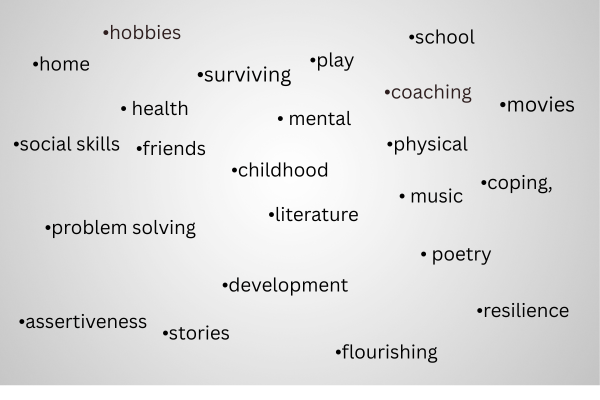
Words! So many words!!
Loose and free! Are they? Or are these words linked?
Why do these words keep whiring in my mind? Perhaps they are more deeply connected than they appear.
Recently, I came across a statement by Professor Shireesh Kedare, Director of IIT Bombay, in The Indian Express (March 6, 2026):
“Coaching culture trains students to game the exam rather than build conceptual understanding. This approach doesn’t work in the IIT system.”
This stayed with me.
My thoughts wandered to the many reports of students resorting to self-harm in prestigious institutions, and to similar incidents in cities where coaching centres thrive but young minds quietly struggle. I even recalled a panel discussion I watched years ago, where heads of IITs spoke about the rising number of student suicides on their campuses.
One remark stuck: many students entering these institutions are those have not read any story books, watched meaningful films, pursued hobbies, or experienced unstructured play. From as early as Grades 6 or 7, they are absorbed into coaching systems. By the time they get here, they are often mentally exhausted, emotionally depleted, and physically inactive.

They are unprepared—not intellectually, but psychologically—for the journey ahead. For years, their singular goal has been to “get in.” Schools, parents, and coaching systems reinforce this idea.
I recall a school leader telling Grade 12 students: “Focus on getting into IIT. Once you’re there, life is set.”
The implication was clear—work relentlessly now, and later you just chill and enjoy life. But reality is very different. And reality hits them hard as nothing, no one prepared them for that.
Many students discover that the pressure does not ease; it intensifies. Without genuine interest in their field, without emotional resilience, and without a broader foundation of experiences, they struggle to cope.
As Professor Kedare also points out in the same idea exchange that some students arrive driven more by the brand value of institutions than by thrir passion for learning. When faced with academic and personal challenges, they falter. He adds that he has seen students spiral—one, for instance, turned to excessive gaming and failed most first-semester courses.
This forces us to question the cost are we chasing success.
It is natural for parents to want the best for their children. But should childhood be sacrificed at the altar of coaching classes? Too often, we hear heartbreaking accounts of children apologizing to their parents for “failing” them—just before taking irreversible step.
Parents may not fully grasp the immense pressure their children carry, or how fragile their mental health can become under it.
So what can be done?
First, we must stop placing the entire weight of expectations on young shoulders. Children need time— for studies, and for life.
Time to play.
Time to explore hobbies.
Time to simply be.
Free play is not a luxury; it is essential. It supports emotional regulation and contributes to mental strength. Physical activity is equally critical—it nurtures both body and mind.
I know of a parent who once said, “She can play after her Class 12 exams. There’s no point wasting time now.”
But is play really a waste of time?
Is it not fundamental to healthy development? Can children truly excel academically if their physical and emotional needs are neglected? Childhood is a critical period of growth—what is missed then cannot be fully recreated later.

Watching reels or playing video games is not the same as running outdoors, playing a sport, or engaging with peers. Through sports and play, children learn to solve problems, follow rules, handle victory and defeat, negotiate, collaborate, and persist. They learn resilience, they thrive.
And yet, while we speak often about social-emotional learning, we rarely give children the space to experience it.
Many parents also dismiss stories, poetry, theatre, or the arts as distractions. “What’s the use?” they ask.
Oh, the use is profound!
Stories build imagination.
Poetry deepens emotional awareness.
The arts cultivate empathy, reflection, and self-expression.
These experiences shape individuals who are not only academically capable, but also socially aware, emotionally intelligent, and truly prepared for life.
If we want our children to flourish and not just succeed—we must rethink what we value.
Now let’s turn to the words we read in the beginning. Those are not separate after all.They are threads of the same fabric.
Your thoughts? 🗨️
🌸Let‘s connect on👇


Leave a Reply