That Teacher’s Day, Arvind, my eighth-grade student, taught me a lesson in empathy.
Teacher’s Day is a special day in schools. As part of a much-loved tradition, students take over the roles of the adults who keep the school running. They become teachers, principals, supervisors, administrators, and members of the non-teaching staff. They plan, organise, manage, and carry out the many little tasks that usually happen quietly in the background.
Students love it. Teachers are amused. And, for one day, we get to feel a little pampered.
Arvind became the peon for the day. He took his role seriously, trying to carry out his duties efficiently. He ran errands, carried registers from one place to another, and was constantly on the move.
The next day, when my class gathered, I asked the students who had taken on different responsibilities to reflect on their experiences and share them with the class.
Most of them said they enjoyed themselves. It was fun to step into someone else’s role for a day.
Then Arvind spoke…What he said made me pause….၊၊||၊
❛ Yesterday I realised how tough Sanjay Bhai’s job is. He has to be on his toes all the time to make sure our classes and exams run smoothly, and we never even realise it.❜
I was touched.
While most of the children had experienced the day as an enjoyable activity, Arvind had experienced something more. For a brief moment, he had stepped into someone else’s world. He had felt the demands of a job he had probably never thought much about before.
And that made me wonder: Isn’t this what empathy is?
Sometimes, we understand another person not by being told what they feel, but by experiencing what they go through.
We talk about teaching children empathy. We tell them to be kind, considerate, and understanding. But perhaps some of the most powerful lessons in empathy come not from what we tell children, but from the opportunities we give them to walk in someone else’s shoes.
The Teacher Didn’t Teach the Meanings. He Taught Something Far More Valuable.
While channel surfing recently, I stumbled across a simple YouTube video that stayed on my mind long after.
A teacher was interacting with a small group of children. He asked each child two simple questions:
❝What is your name?❞ ❝Do you know what your name means?❞
One by one, the children answered. Everyone knew their names, of course, but very few knew what those names actually meant.
What impressed me was the teacher’s response. No comments, no judgements, just a smile and he moved on to the next child. When everyone had answered, it turned out that only two students out of fifteen knew the meanings of their names.
He told the children to find out the meaning of their names. Not immediately. Not as homework due the next day. “Take two days, four days, even a week, if you have to”.
Then the teacher said something beautiful.
Then he explained why he had asked the question in the first place.
❝It is not the meaning that is important. What matters is your curiosity. I want you to be curious to know—to ask questions, to understand the meanings behind things, and to want to know about the world around you.❞
That was the real lesson. In just a few minutes, he shifted the focus from knowing the right answer to developing the desire to seek answers.
And that, to me, is what distinguishes a great teacher from an ordinary one. An ordinary teacher may focus on delivering information. A great teacher awakens curiosity.
Curious children don’t stop learning when the lesson ends. They ask “why,” “how,” and “what if.” They observe, explore, question, and discover. They become lifelong learners because they have developed the habit of seeking understanding rather than simply collecting information. That lesson extends far beyond the classroom.
Whether it’s the story behind their own name, the reason the sky changes color at sunset, why leaves fall in autumn, or how kindness changes relationships—every question is an opportunity to nurture curiosity.
Over to you🎤. Drop your thoughts in the comments. ⋆✴︎˚。⋆
Two news stories that I read lately have stayed with me. The stories highlight how parents influence our thoughts, desires, choices and our personalities for ever.
The first is about a man in his seventies who appeared for the NEET (National Eligiblility cum Entrance Test) for medical entrance.
Why⍰To fulfil his late mother’s wish.
The second is about a woman who became a Chartered Accountant after clearing one of the toughest professional exams and against all odds at the age of 52. In doing so she bravely juggled with her studies and mid-life family responsibilities, her daughter’s wedding and tending to her mother-in-law during her final illness.
Why ⍰Because she wanted to gift her degree to her father on his 75th birthday.
What connects these two stories?
In both cases they took on challenges that many would consider impossible at their age. And both were driven by the same powerful motivation—the desire to make their parents proud.
💭Time to pause and reflect. A child’s longing for their parents’ appreciation doesn’t disappear with age. It stays with them throughout their lives. That’s the extraordinary influence parents have.
Here’s my message to parents: As parents, we often underestimate the impact we have. Recognize the power you hold. Be conscious of the impact you have. Your influence is far greater and more enduring than you may realize.You can shape lives and inspire greatness. You give roots and wings .ᐟ.ᐟᝰ.ᐟ
Parenting is not just about raising children. It’s about leaving a legacy of belief that continues to inspire them throughout their lives. ⋆✴︎˚。⋆
Over to you 🎤What is one thing you’ve done—or still hope to do—to make your parents proud? Share your story in comments ⤵️
Daily prompt: What’s something you used to believe as a kid that seems ridiculous now?
✍️Not one, I’d share quite a few.
✦ One of my earliest beliefs was that someone might steal my mother. So I would cling to her constantly, her finger, her hand, or her pallu—just to make sure she stayed close.
✦ Then there were the “flying snakes.” The real ones that could swoop over me and finish me anywhere, anytime. For a stretch of my childhood, roughly between ages five and seven, I was genuinely terrified and I did not share it with anyone. Much later in some encyclopaedia I read –
‘Flying snakes are real. However, they don’t exactly fly; instead, they are expert gliders. They belong to the genus Chrysopelea and are found in the tropical rainforests of Southeast Asia, parts of China and India.’ Yes, you read it right, India also!
✦ Another belief took hold a little later, around ages seven to nine. I remember being told (or perhaps misunderstanding something I heard) that I swallowed frog eggs with water, they would lodge in my brain and turn into toads. 🐸
✦Then came my early teens, when I believed I was some kind of genius. 💡 I assumed good marks were inevitable for me, and that studying was something others—those with “lesser brains”—needed to do. That belief was completely shattered after my 10th board results, when I fell flat on my face academically, I mean scraped somehow. It was a humbling moment, but also a turning point. After that “fiasco,” I began to study seriously—and actually did well in all the years that followed. 💯✍️🧠📚
✦ I think after that, my beliefs became a little more grounded… and significantly less entertaining. ツ
India has a rich tradition of multilingualism. Most of us grow up speaking two or three languages, thanks to the country’s incredible cultural and linguistic diversity.
I was reminded of this during an interaction at the University of Rhode Island. A young student asked me,
❝Renu, how many languages do you know?❞
I began modestly: ❝Hindi, English…❞ But perhaps I was in a slightly indulgent mood that day, so I continued, ❝…some Gujarati, I have studied Sanskrit, and I can understand and appreciate Urdu as well.❞
He looked visibly astonished—eyes widened, mouth slightly open. ❝ That’s quite a lot!❞ he said.
To keep the conversation going, I asked him the same question. He looked down, raised one finger, and replied somewhat sheepishly, ❝Only one.❞ I instantly regretted putting him in that spot.
(⸝⸝ᵕᴗᵕ⸝⸝) During the same informal interaction, someone shared a lighthearted joke:
❝ What do we call someone who speaks many languages?❞ ❝Multilingual.❞
❝Two languages? ❞ ❝Bilingual.❞
❝ And one language? ❞ ❝ …American.❞
Clearly meant in jest. But the stereotype made us reflect. It also set the stage for a deeper discussion on MULTILINGUALISM.
Soon, the conversation shifted to research in psychology and neuroscience, which shows that multilingualism is far more than just a communication skill—it is a cognitive advantage. From enhancing memory and problem-solving abilities to improving focus, fostering empathy, and even delaying cognitive decline, the benefits are both wide-ranging and well documented.
Multilingualism—the ability to use two or more languages—has profound effects on the brain’s structure and function. These advantages stem from the continuous mental exercise involved in managing multiple languages , strengthening executive functioning and mental flexibility.
India’s own intellectual and political leaders strongly advocated multilingualism. Figures like Mahatma Gandhi, Jawaharlal Nehru, Rabindranath Tagore, and B. R. Ambedkar believed that learning multiple languages expands the mind, builds cultural bridges, and serves as a powerful tool for social mobility and empowerment.
Reflecting this vision, educational policies in India have long supported the three-language formula. Recently, CBSE curriculum for 2026–27 has made a third language mandatory from Class 6. The National Education Policy’s emphasis on Indian languages. While some argue that this may limit the choice of foreign languages for students, many institutions are creatively addressing this by introducing language clubs and extracurricular opportunities.
I often hear parents express concern about the increasing academic load due to the additional language requirement. However, what is often overlooked are the significant cognitive benefits of language learning. It contributes to brain development, enhances executive functioning, improves focus, and nurtures creativity—while also strengthening communication and social skills.
At a time when global research strongly supports the advantages of multilingualism, it may be worth rethinking these concerns. Instead of viewing it as a burden, we could see it as an investment in a child’s intellectual and personal growth.
As the contemporary linguist G. N. Devy, who has documented hundreds of Indian languages through the People’s Linguistic Survey of India, aptly reminds us:
Losing languages means losing ways of understanding life.
Loose and free! Are they? Or are these words linked?
Why do these words keep whiring in my mind? Perhaps they are more deeply connected than they appear.
Recently, I came across a statement by Professor Shireesh Kedare, Director of IIT Bombay, in The Indian Express (March 6, 2026): “Coaching culture trains students to game the exam rather than build conceptual understanding. This approach doesn’t work in the IIT system.”
This stayed with me.
My thoughts wandered to the many reports of students resorting to self-harm in prestigious institutions, and to similar incidents in cities where coaching centres thrive but young minds quietly struggle. I even recalled a panel discussion I watched years ago, where heads of IITs spoke about the rising number of student suicides on their campuses.
One remark stuck: many students entering these institutions are those have not read any story books, watched meaningful films, pursued hobbies, or experienced unstructured play. From as early as Grades 6 or 7, they are absorbed into coaching systems. By the time they get here, they are often mentally exhausted, emotionally depleted, and physically inactive.
They are unprepared—not intellectually, but psychologically—for the journey ahead. For years, their singular goal has been to “get in.” Schools, parents, and coaching systems reinforce this idea.
I recall a school leader telling Grade 12 students: “Focus on getting into IIT. Once you’re there, life is set.” The implication was clear—work relentlessly now, and later you just chill and enjoy life. But reality is very different. And reality hits them hard as nothing, no one prepared them for that.
Many students discover that the pressure does not ease; it intensifies. Without genuine interest in their field, without emotional resilience, and without a broader foundation of experiences, they struggle to cope.
As Professor Kedare also points out in the same idea exchange that some students arrive driven more by the brand value of institutions than by thrir passion for learning. When faced with academic and personal challenges, they falter. He adds that he has seen students spiral—one, for instance, turned to excessive gaming and failed most first-semester courses.
This forces us to question the cost are we chasing success.
It is natural for parents to want the best for their children. But should childhood be sacrificed at the altar of coaching classes? Too often, we hear heartbreaking accounts of children apologizing to their parents for “failing” them—just before taking irreversible step.
Parents may not fully grasp the immense pressure their children carry, or how fragile their mental health can become under it.
So what can be done?
First, we must stop placing the entire weight of expectations on young shoulders. Children need time— for studies, and for life.
Time to play. Time to explore hobbies. Time to simply be.
Free play is not a luxury; it is essential. It supports emotional regulation and contributes to mental strength. Physical activity is equally critical—it nurtures both body and mind.
I know of a parent who once said, “She can play after her Class 12 exams. There’s no point wasting time now.” But is play really a waste of time?
Is it not fundamental to healthy development? Can children truly excel academically if their physical and emotional needs are neglected? Childhood is a critical period of growth—what is missed then cannot be fully recreated later.
Watching reels or playing video games is not the same as running outdoors, playing a sport, or engaging with peers. Through sports and play, children learn to solve problems, follow rules, handle victory and defeat, negotiate, collaborate, and persist. They learn resilience, they thrive.
And yet, while we speak often about social-emotional learning, we rarely give children the space to experience it.
Many parents also dismiss stories, poetry, theatre, or the arts as distractions. “What’s the use?” they ask.
Oh, the use is profound!
Stories build imagination. Poetry deepens emotional awareness. The arts cultivate empathy, reflection, and self-expression.
These experiences shape individuals who are not only academically capable, but also socially aware, emotionally intelligent, and truly prepared for life.
If we want our children to flourish and not just succeed—we must rethink what we value.
Now let’s turn to the words we read in the beginning. Those are not separate after all.They are threads of the same fabric.
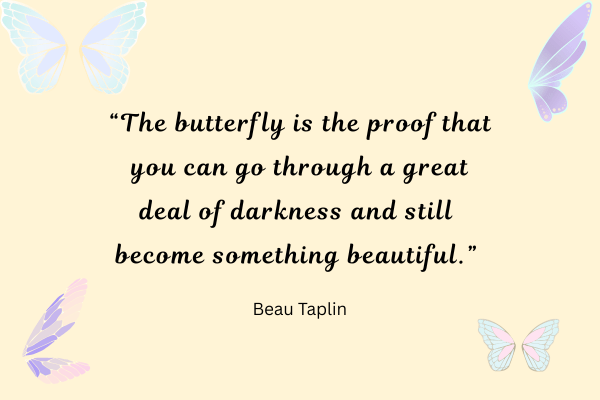
The first thing that comes to my mind as I read this prompt is a quote I stumbled upon this morning—
It instantly brought someone to my mind. Someone going through a difficult time, nursing a heartbreak, weighed down by disappointment, struggling to move forward through the negativity.
I shared this thought with her, hoping it would remind her that even in the darkest phases, something meaningful is possibly taking shape beneath the surface.
We often celebrate growth when it’s visible—when the transformation is complete. But we rarely talk about the in-between: the confusion, the self-doubt, the negativity, the waiting…
Research in positive psychology supports this unseen phase of growth. The concept of post-traumatic growth, introduced by psychologists Richard Tedeschi and Lawrence Calhoun, suggests that people can experience profound personal development after adversity. It’s not the pain itself that transforms us, but the way we process, reflect and rebuild. 🤍☁️🌿🍃✨️
And yet, while research gives us language for this transformation, living through it is messy.
And it’s not just about heartbreak. It could be any loss, any setback, any moment where life feels heavier than usual. These are the times when faith feels fragile and hope feels elusive—but they are also the moments that shape our better version.
Growth happens in the dark too! Save this for difficult days when it feels overwhelming. ⋆.˚🦋༘⋆
ꜛ The above quote resonates deeply with me. It suggests a powerful yet simple idea: we can learn something from everyone we meet. The only requirement is where we choose to place our focus. If we train ourselves to notice strengths, qualities, and positives in others, every interaction becomes an opportunity for growth,IF, if we “have a heart that watches and receives” (expression borrowed from the great english poet William Wordsworth)
›This way of thinking closely aligns with the essence of positive psychology—a strength-focused approach. What we focus on grows. If we train our eyes to see gems, the world begins to feel richer, wiser, and more generous.
› At the same time, learning is not just about others—it is about our willingness to be taught. If you are truly willing to learn, every experience and interaction—whether positive or negative—holds a lesson. But for that, one must be teachable. When we cultivate that openness, the entire universe becomes our teacher.
›In his poem ‘The Tables Turned’ William Wordsworth captured this beautifully when he wrote, “Let nature be your teacher.” He believed that:
❝One impulse from a vernal wood May teach you more of man, Of moral evil and of good, Than all the sages can.❞
∗(From: The Tables Turned) These lines remind us that wisdom is woven into the world around us.
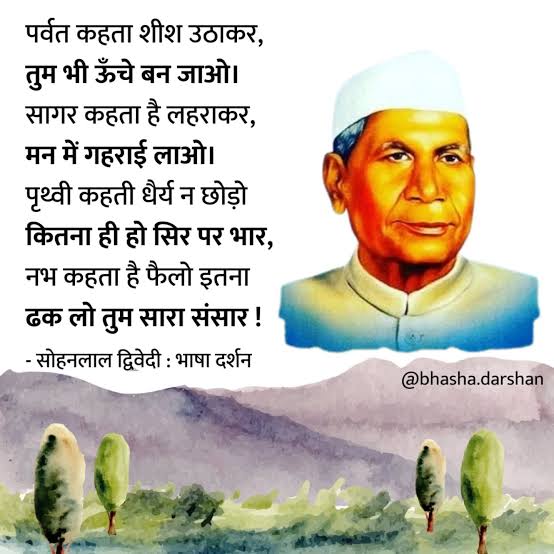
››As I write, I’m reminded of a poem I encountered in school, probably in the fifth grade. At that age, perhaps we are too young to fully grasp its depth, yet the message quietly stays with us. Meaning unfolds, as we grow. The image below is found on the internet.
››I sum up the main idea that the poem conveys. It draws lessons from nature in the most beautiful way. The mountain, standing tall and firm, teaches us to hold our heads high—to be grounded, resilient, and unwavering in our values. The ocean, vast and deep, reminds us that our thoughts, too, should have depth, encouraging us to think critically rather than remain superficial.
›The earth, patient and enduring, teaches us to carry our responsibilities without complaint. And the sky, limitless and expansive, inspires us to grow beyond boundaries—to embrace a perspective wide enough to include the whole world.
🎯The poem is really about developing essential life skills.🪴 It speaks of courage—the courage to stand for what is right. It nurtures assertiveness, resilience, and the ability to think deeply. It encourages problem-solving and thoughtful decision-making. And above all, it fosters empathy—the kind that allows us to consider every soul on this planet.
›Perhaps the lesson is simple yet profound: if we are willing to learn, teachers are everywhere. In people. In experiences. In nature. In life itself. 🌿⚘.⋆🍃༄
✍️ Over to you:What’s your take? Share your thoughts in the comments below! 💬
🌸 Here’s to the women pave the way for future generations, who provide both roots and wings!
🍃On March 8, we celebrate the X — the mark of creation. Beyond biology lies brilliance, the quiet strength, the capacity. The capacity to nurture without losing strength, to lead with empathy, to raise emotionally secure children.
It’s about power — expressed with grace, the soft power. 🍀
No, we don’t compete for power. We are power. Before you disagree let me elaborate my point.
Let’s bring genetics into the conversation. X chromosome contains significantly greater number of genes. Then, certain conditions (mitochondrial) can be inherited down the maternal line only.
🍃Well, leave the genetics aside and consider socialization. Although fathers’ involvement in child-rearing is increasing, yet studies indicate that, on average, mothers spend significantly more time on direct childcare and daily routines compared to fathers. Understandably, mothers have a greater impact on their children’s behavior, attitudes, and personalities. So, until the time men take equal share of child rearing responsibilities, women would continue to lead not just support.
Oh, does this sound divisive? Allow me be an unapologetic feminist today 🙂 Happy Women’s Day! 💐