A Small Intervention That Worked – And what worked for me might work for others too. Hence sharing with you a moment of connection and breakthrough…
“He behaves very badly. If he doesn’t understand anything or doesn’t know the answer, he completely loses control… yes, at home and in school… You know what he did once? During an online class at home, when the teacher asked him a question, he threw his book at the the computer screen… he tears his books and notebooks, or makes ugly scribbles on them. He simply cannot control it.”
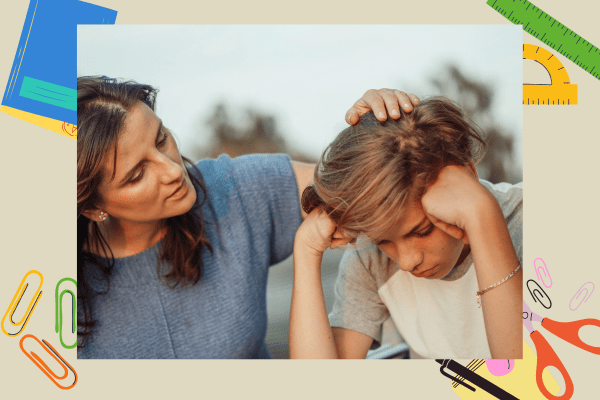
This was a mother describing her 8-year-old son to me, while the boy sat beside her, visibly uncomfortable and irritated at being the topic of discussion.
I turned to him and smiled. He tried to return it, but couldn’t quite manage. I didn’t rush into questions about the problem. Instead, I began by engaging him gently—asking about his class, his favourite sport, his favourite subject. As he gradually settled and began to feel a little safer, I shifted the conversation.
Looking at him calmly, I asked, “Do you get very angry when you don’t know something?” … the boy simply nodded.. I continued “So angry that you feel like tearing your book or scratching it hard with your pencil?”
“Yes,” he replied in a voice barely audible as if waiting to get an earful from me next moment.
“Okay… And you know what? You can do that.’ I added looking straight at him.
He looked up, startled. That was not the response he was expecting. He glanced at his mother, then back at me, as if trying to make sense of what he had just heard.
I continued slowly, “It’s okay to feel upset and angry. But next time When you feel that way, instead of scratching your school book or notebook, you use a rough notebook—an old one you don’t need anymore. You can tear it, scribble on it, even crumple it into a ball and throw it away. That way, the anger comes out, but nothing important gets damaged. Does it make sense to you? Do you think you could try that?”
He paused for a moment, then nodded thoughtfully.
Throughout this exchange, his mother listened quietly.
I then spoke with her about the importance of helping children find safe and acceptable ways to express overwhelming emotions, rather than trying to suppress or punish the expression itself. Children often need permission and guidance to channel anger in ways that do not harm themselves, others, or relationships.
It has now been around six months since that session. In all this time, all I have heard from the mother, is “Thank you.”
Sometimes, what looks like a complicated behavioural problem is really a child struggling without tools. And sometimes, a small shift in how we respond becomes the first tool they truly learn to use.
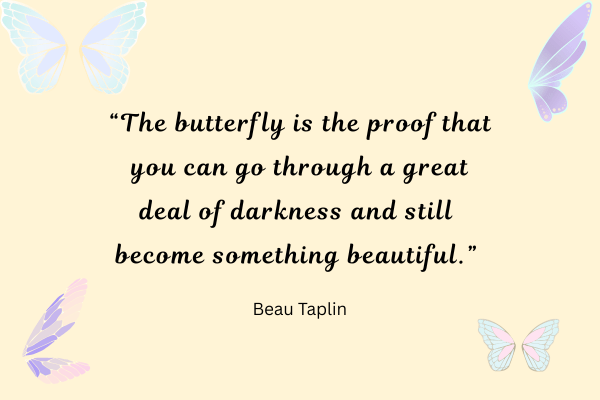
The first thing that comes to my mind as I read this prompt is a quote I stumbled upon this morning—
It instantly brought someone to my mind. Someone going through a difficult time, nursing a heartbreak, weighed down by disappointment, struggling to move forward through the negativity.
I shared this thought with her, hoping it would remind her that even in the darkest phases, something meaningful is possibly taking shape beneath the surface.
We often celebrate growth when it’s visible—when the transformation is complete. But we rarely talk about the in-between: the confusion, the self-doubt, the negativity, the waiting…
Research in positive psychology supports this unseen phase of growth. The concept of post-traumatic growth, introduced by psychologists Richard Tedeschi and Lawrence Calhoun, suggests that people can experience profound personal development after adversity. It’s not the pain itself that transforms us, but the way we process, reflect and rebuild. 🤍☁️🌿🍃✨️
And yet, while research gives us language for this transformation, living through it is messy.
And it’s not just about heartbreak. It could be any loss, any setback, any moment where life feels heavier than usual. These are the times when faith feels fragile and hope feels elusive—but they are also the moments that shape our better version.
Growth happens in the dark too! Save this for difficult days when it feels overwhelming. ⋆.˚🦋༘⋆
✦I hope to support the community at its most foundational level by empowering parents, teachers, and caregivers with practical ideas and meaningful strategies.
✦When the adults in a child’s world feel equipped and confident, children are more likely to flourish—reaching their full potential while growing into individuals who are socially and culturally competent, and physically, mentally, and academically strong. This vision is deeply personal to me, and it is what has led me here @ Roots n Wings.
Raising Kids & Shaping Future
⚡When I look around, I feel a growing urgency. We constantly read and hear about the challenges children face today—fragile mental health, low frustration tolerance, and an increasing need for instant gratification. Alongside this, digital addiction has emerged as a modern epidemic, often contributing to behavioral and emotional concerns.
⚡Adolescents, especially, are navigating a demanding world—balancing parental expectations, peer pressure, bullying, and their own inner questions about identity and belonging. At the same time, many parents and educational systems are still adapting to these rapidly changing needs. The increasing cases of self-harm among students remind us that we need to pause, reflect, and respond with greater sensitivity.
💫This is where I believe positive psychology can make a real difference.
It is not just about addressing problems after they arise, but about preventing them—building emotional strength, resilience, and awareness early on. It complements therapy by creating a strong foundation for well-being.
✦With my background in teaching, along with my training as a counselor and therapist, I feel prepared to contribute to this space. While I know my journey is still in its early stages, my intention is clear—to reach more people, to share what I’ve learned, and to make a meaningful difference.
✦And most importantly, I believe this with conviction—I am ready for this.
ꜛ The above quote resonates deeply with me. It suggests a powerful yet simple idea: we can learn something from everyone we meet. The only requirement is where we choose to place our focus. If we train ourselves to notice strengths, qualities, and positives in others, every interaction becomes an opportunity for growth,IF, if we “have a heart that watches and receives” (expression borrowed from the great english poet William Wordsworth)
›This way of thinking closely aligns with the essence of positive psychology—a strength-focused approach. What we focus on grows. If we train our eyes to see gems, the world begins to feel richer, wiser, and more generous.
› At the same time, learning is not just about others—it is about our willingness to be taught. If you are truly willing to learn, every experience and interaction—whether positive or negative—holds a lesson. But for that, one must be teachable. When we cultivate that openness, the entire universe becomes our teacher.
›In his poem ‘The Tables Turned’ William Wordsworth captured this beautifully when he wrote, “Let nature be your teacher.” He believed that:
❝One impulse from a vernal wood May teach you more of man, Of moral evil and of good, Than all the sages can.❞
∗(From: The Tables Turned) These lines remind us that wisdom is woven into the world around us.
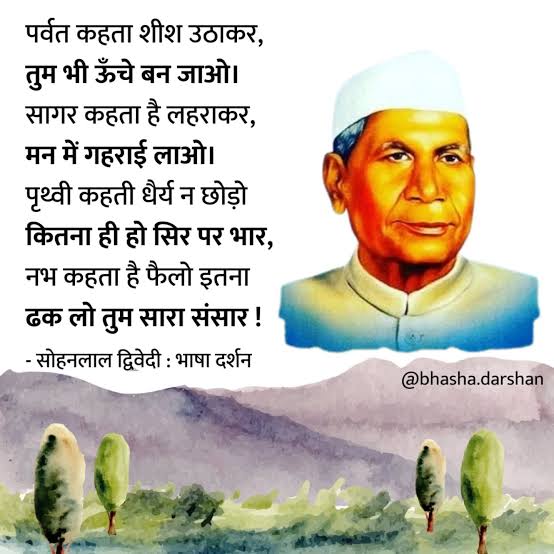
››As I write, I’m reminded of a poem I encountered in school, probably in the fifth grade. At that age, perhaps we are too young to fully grasp its depth, yet the message quietly stays with us. Meaning unfolds, as we grow. The image below is found on the internet.
››I sum up the main idea that the poem conveys. It draws lessons from nature in the most beautiful way. The mountain, standing tall and firm, teaches us to hold our heads high—to be grounded, resilient, and unwavering in our values. The ocean, vast and deep, reminds us that our thoughts, too, should have depth, encouraging us to think critically rather than remain superficial.
›The earth, patient and enduring, teaches us to carry our responsibilities without complaint. And the sky, limitless and expansive, inspires us to grow beyond boundaries—to embrace a perspective wide enough to include the whole world.
🎯The poem is really about developing essential life skills.🪴 It speaks of courage—the courage to stand for what is right. It nurtures assertiveness, resilience, and the ability to think deeply. It encourages problem-solving and thoughtful decision-making. And above all, it fosters empathy—the kind that allows us to consider every soul on this planet.
›Perhaps the lesson is simple yet profound: if we are willing to learn, teachers are everywhere. In people. In experiences. In nature. In life itself. 🌿⚘.⋆🍃༄
✍️ Over to you:What’s your take? Share your thoughts in the comments below! 💬
I was people watching while waiting for someone at the airport arrivals area. People at the arrivals generally look happy to be joined by their families and friends.They greet and hug their loved ones. They might have waited for this moment for a long time.
One such union I watched up close. It looked like a homecoming of a young man in late twenties. First the mother, so I assumed, hugged him and gave a peck on the cheek. The young man looked embarrassed being so petted by his mother like this. Then the Indian father who looked equally delighted to see his son but being less expansive in his affection gave a pat on his shoulder. Then came the younger sister who was eagerly waiting for her turn and lifted herself a little to hug her brother whose smiling face was visible to me while the girl’s back was turned towards me. At this moment I, an indifferent observer, found myself struggling to hold back my tears for I didn’t want to be seen crying and I had no reason to. As the girl released her rather longish hug and turned her face, I could see her tears while the brother and the parents smiled a tender smile.
𖡎 How did that happen? I was observing only because all this was happening where I was standing and without any special interest. Still my eyes moistened when the little sister hugged her brother, though I did not see her tears.
Were the mirror neurons firing in my brain? 🧠⚡🧠
𖡎 The teacher in me was intrigued with this behaviour. And the first thought I had was if this knowledge of mirror neurons could help teachers, parents and children. I had read about mirror neurons in Dr John Medina’s book ‘Brain Rules’, but I searched some more. This is what I learnt-
Mirror neurons are cells whose activity reflect their surroundings. Giacomo Rizzolatti, an Italian neurophysiologist and his team are credited with discovering mirror neurons. Their paper on mirror neurons was published in 1990. While performing an experiment on macaque monkeys they observed that the neurons that fired when monkeys picked raisins, also fired when they saw someone else doing the same and even when monkeys did not actually see someone doing it. Later research suggested that mirror neurons respond not so much the physical movement itself, but the intention. This explains my behaviour that day at the airport arrivals area. 🧠⚡🧠
Having understood the mirror neuron phenomenon I started wondering how that can be applied to in classrooms and home settings and how mirror neurons can support learning. ⋆。°·☁︎
🚨The first thing we have to know that there’s a mirror brain and if there is, we adults can make use of this in the classroom and home to inculcate the desired behaviour. I mean, we can use this brain behaviour to our advantage in shaping children’s behaviour. This corroborates Albert Bandura’s Social Learning Theory which emphasises imitation and modelling.
Teachers and guardians can model enthusiasm, curiosity, respect and even thinking processes by solving a problem aloud. and verbalizing thought processes. Self awareness is the key to modelling.
🚨We can teach children calm, emotional regulation, respond to signals by modelling responses intentionally and consistently. And there’s enough evidence to show that calm, secure and emotionally regulated children not only perform better academically, but are more emotionally intelligent and socially competent also.
❝Don’t worry that your children don’t listen to you, worry that they watch you ❞ This famous parenting quote does encapsulate profound wisdom. So next time you yell at children or tell them not to fritter away time online, remember the mirror brain.
Have more thoughts or tips on this? Share those in the comments below. 💭
── ⋆⋅☆⋅⋆ Write your injuries in dust, your benefits in marble. ⋆⋅☆⋅⋆ ── Benjamin Franklin
🧠The above quote contains a wealth of wisdom and the essence of strength-focused positive psychology.
๋࣭⭑Before I discuss the above aphorism, I’d like to draw your attention to a piece of information related to neuroscience. In 2005, the National Science Foundation published an article regarding research about human thoughts per day. The average person has about 12,000 to 60,000 thoughts per day. Of those 95% are exactly the same repetitive thoughts as the day before and about 80% are negative. (Source: 22 Facts About the Brain By Julia Burket)
๋࣭⭑Two points need highlighting.⭑One, most of our thoughts are repetitive. ⭑⭑Two, most of our thoughts are negative. So, choosing happiness would mean a mindshift and being aware of our thoughts. In the light of the above facts the advice that Franklin offers holds significant merit. Let’s analyse what advice does this aphorism offer.
๋࣭⭑The first part suggests ✦ ‘Write the injuries in dust.’── .✦ What will happen if we do so? The sand of time would heal our wounds. Just as no mark, however deep, made on the sand stays there for long, our wounds will also heal soon if we let them. The past can only hurt as much as we let it. And we let it by not making a conscious effort to stop our repetitive thoughts about the painful past. If we don’t cling to our hurtful experiences and let go of hurt, it can be easily erased like writing in dust. The basic idea is that we should not allow grudges or offenses be permanently stored in your mind or heart. 🌿
๋࣭⭑Write ✦Your benefits in marble ── .✦This part of the quote encourages us to remember the kindnesses, blessings, and good deeds we receive and cherish eternally. We should treasure good things. We should dwell on the happy experiences a little more, a little longer. The memory of positive events creates positive emotions that’s why those memories should be permanent like etching on marble.
๋࣭⭑How do we write our benefits in marble? Positive psychology answers. Practice gratitude. This would redirect our repetitive thoughts in the positive direction. To quote Martin Seligman ✦Happy people remember more good events than actually happened, and they forget more of the bad events. Depressed people, in contrast, are accurate about both── .✦ If we hold on to the good things in life, remember them often and treasure happy memories forever, it would be ike a benefit etched in marble which cannot be erased. 🍃
๋࣭⭑Do you see, that the quote above so completely aligns with the core ideas of rather modern positive psychology.ᐟ.ᐟ It was actually written in 18th C .ᐟ.ᐟ The point I’m trying to make is that positive psychology existed even before it came recognised as a subfield of psychology (1998)! Psychology itself became its own discipline only in late 19th C when the first psychology laboratory was opened in Germany!And it shouldn’t surprise us as gravity existed even before Newton gave it a name and the theory that Gravity is the force by which earth or other planets attract objects. 💡
✱AboutBenjamin Franklin to whom the quote belongs. He is known as one of the founding fathers of the United States of America, lived in 18th C. He was a writer, inventor, stateman, publisher and a philosopher. He wielded great influence on American psyche at the time when social influencer were not known.
🎤Over to you. Share your thoughts in the comments below!
Praise is a skill, not just a spontaneous utterance.It is a powerful tool in the hands of those who are responsible for children’s education and upbringing. Like all powerful tools it has to be used carefully and mindfully.
Children instinctively respond to praise. Much before their language develops they recognize praise in your smile and in your eyes. And when they sense your approval and appreciation they repeat the same act again and again. Just to please you. The right praise, offered at the right moment and in the right manner can work wonders.
I think BF Skinner did a great service to mankind by propounding Learning by Conditioning and its key concept of reinforcement. Through his experiments he showed that behaviours followed by a reward are more likely to be repeated. And praise is one such reward. A child can be rewarded in other ways too, with a gift, with a treat, but immediate praise is the most handy and effective award. If used skilfully, this tool can mould the child the way you want and you’ll find that gradually your nagging is also tailing off. So, it’s like getting double benefit, getting two-for-one. ‘Spare the rod, spoil the child’ is old school. The proverbial rod can be done away with. Punishment doesn’t bring any lasting change, instead it causes anger and hostility. Well, our focus here is not the rod, but praise and how it can be used bring desired changes in the child behaviour. Yes, Change is possible!
Which compliments would motivate the child and reinforce the desirable behaviour?
Here’s my manual on how to pack more power to praise –
✦︎What to praise?
Praise the behaviour you want to reinforce. Let’s say, you want the child to keep her things properly, or to be polite and helping to her friends in the class or to be ready on time for school. Depending on the age and developmental stage of the child, identify the behaviour you want the child to repeat.
Talk to the child about the importance of a good habit/behaviour you want her to acquire. Talk, connect without being after the child about the same thing all the time, nor expect complete compliance or perfect behaviour immediately. For the sake of peace you can ignore the undesired behaviour once in a while, but don’t ignore it when the child takes even a tiny step in the right direction, that’s your opportunity, seize it. Small efforts bring big change. This is positive psychology. This is positive parenting. Be alert, catch these small steps, these small moments, and let the child know that her efforts are recognised and appreciated, ‘Today you got ready earlier than yesterday, next time try to get ready by…’ ‘I really like you are trying to be on time’ ‘your table/shelf looks tidy today. Thanks for organising it so well.’ ‘You let your friend play with your ball. That’s good.’ The smallest progress should be made a news for the child and other family members or for the class. As I often say ‘News of the difference makes a difference.’ Not just verbally, offer nonverbal praise too, smile, hug, touch, gentle look would give more power to your words.
✦︎When to praise?
As soon as you notice improved behaviour or as soon as possible. Delayed praise brings diminished returns. Sometimes for practical reasons you cannot offer praise immediately which shouldn’t be a cause of concern, take it easy. Parenting is not about perfection. You can even convey through someone else if that is possible. That also works well. Child would feel motivated when someone at home will tell her ‘Pa is pleased that you learnt your lesson all by yourself.’
I recall an incident. On one occasion my colleague conveyed my genuine praise to my 12th grade student who had lately started taking more interest in studies. While she was taking my proxy she told him ‘Renu ma’am was very happy with your work. She told me you have acquired a good understanding of the concepts and you express yourself beautifully.’ Need I tell you this communication boosted that student’s self-esteem forever and he started participating in my class more actively. It was so thoughtful my friend to communicate my genuine praise to the right person.And praise works for all children irespective of their age. It will make lasting changes in the behaviour.
✦︎How to praise?
Don’t wait for the perfect result. Don’t keep telling ‘Not good enough, try harder.’ It’s so demotivating. One statement can put the child off the track. Instead say, ‘You’re trying really hard, you’ll get there. This is how we all learn.’ Focus on effort, outcome can wait.Doesn’t The Bhagwat Gita also teach the same thing? Focus on your actions and not on the result of your actions.
•Again praise actions, behaviour, not the personality. Say ‘I like that you always talk to your elders with respect’ and not ‘you are a nice girl’ ‘you are a genius’etc.
•The more specific the praise, the more effective it will be in reinforcing the desired behaviour.
•Let non verbal praise complement your words of praise.
✦︎How much praise is good and how much is too much?
If your praise is genuine and sincere, it can’t possibly be too much. It would be just right. According to Alan Kazdin, a Yale professor and Director of Yale Parenting Centre ‘You might be concerned about praise spoiling the child. But both research and clinical experience suggests this is not really an issue.’ He further adds that we are not likely to praise too much because of our negativity bias which means our tendency to look for what is wrong.
🚦A word of caution here:
Heaping the child with compliments for nothing particular will do more harm than good. Also, use praise for reinforcement, not for coaxing and manipulation.
Thus, praise is a skill and a very crucial onefor parents and educators to acquire in order to modify children’s behaviour and inculcate growth mindset in them.Developing this skill involves continuous practice and refinement.
🗪 I’d love to know what’s your take on this subject? Leave your thoughts in the comment box.
Since this space is about nurturing and educating with positive psychology it would only be appropriate to decode positive psychology for you at the outset.
Positive psychology emerged as a scientific framework at the cusp of 21st century. It is a subfield within psychology and Martin Seligman, a prominent American psychologist, is called the father of positive psychology. Its distinctive feature is its strengths-focused approach.
Though in the more recent years it has created quite a buzz yet not many people know that it is born out of years of scientific research and studies by psychologists like Seligman and Mihaly. Carol Dweck, Jonathan Haidt, Christopher Peterson are some of the leading names in the field. As Peterson puts it “…positive psychology is not to be confused with untested self-help…”. Here I’m trying to answer some of the questions that may already be swarming your mind.
What is strengths-focused approach?
Strengths-focused approach focuses on the strengths of individuals rather than on their shortcomings. There are moments when people are not ill or unhappy (no negative feelings) and yet they don’t feel happy or strong either(no positive feeling). This is where positive comes in. It aims at fostering happiness, strength and well being. And whatever we focus on multiplies, grows. Focus on health, happiness, hope, gratitude, interest, positive relationships enhances well-being, happiness and life satisfaction.
In other words, positive psychology is not all about fixing problems but about promoting strengths and making life worth living. This is what Seligman means when he says “The best therapists do not merely heal damage; they help people identify and build their strengths and their virtues.”
Is it the same as positive thinking?
That’s a common confusion. The basic difference between the two is- positive thinking is a mindset that expects good outcomes always, while positive psychology is a scientific study based on research.
Positive psychology is more realistic. It accepts that things may go wrong too. It understands and acknowledges negative feelings without giving them more power. It moves ahead to nurture strength and fulfilment.
How is it different from the psychology as we have always known?
As for Psychology as we know or let’s say traditional psychology, the primary concern is illness, disorder and dysfunction. Traditional psychology fixes what is wrong. It’s about surviving. On the other hand, Positive psychology interventions are about improving emotional health, social relations, and outlook by creating positive emotions, building capabilities and creating positive relationships.
And this is the main and the only difference. In the end, these two don’t contradict each other. In fact, they complement each other.
Enough! This is getting too long and theoretical. Alright, having gained the direction and the basic understanding of positive psychology, we now can glide into practical applications on how we can help kids (and adolescents) achieve their full potential and fulfilment.
Have more questions? Drop them in the comment section.
Before I get into the ‘Why’, allow me a moment to expand on ‘You’. ‘You’ means- parents, not just biological parents, but all those who are into child rearing whether professionals or family members. Since there is no clear line separating them, I consider the entire community of child and adolescent carers as one. A teacher may be a parent too, a parent may teach too and a care giver may be a family member and so on. And therefore, the content posted on Roots n Wings will be relevant to all.
Now the ‘Why’. Why should you dive into my content?
A fair question. Well, I’m certain your role comes with challenges which if met with innovative approaches involving critical thinking, creative thinking and self-regulation would bring better results . On how well you carry out your role and responsibilities, will depend how well the children will do throughout their developmental stages, how well they cope with stressors and how resilient and confident they become as they grow. It’s crucial for you to be aware and informed about child development and behaviour to be able to manage their quirks and tantrums, to make the child feel secure and open to share her stories with you which is equally important for the child and for the carer. This creates a healthy connection with the child which is absolutely essential for her well-being and emotional development from early childhood to turbulent teens.
Here is ‘My Why’.
For the well-being and healthy growth of the plant we water roots, give nutrients to the soil. Result? The plant turns into a tree strong enough to weather any storm. It not only survives, it thrives. This is what we want for our children. Same way, parents are the roots and all the microsphere around the child is the soil. And my mission is to fortify the roots and soil so that children achieve their full potential.
A little about my credentials. I’ll not repeat what I have already shared in the opening post. But would like to add some more to it. I got several opportunities to attend trainings, both virtual and in-person, at some prestigious universities in the US which gave me ample exposure to the common global practices. Some important trainings I enumerate here- Professional Development for teacher trainer from Arizona State University and Power Skills in Classroom, which is about developing social emotional competence among children, from University of Massachusetts, Lowell. These two were virtual exchanges. Another that I attended in-person was on Service Learning at the University of Rhode Island. The last one is about serving the society by sharing the learning and I am really keen on sharing with everyone, who can actually benefit from me and can further transfer the benefits to the younger generation. Just to set off a cascading effect!
I can’t sign off without a word on Positive Psychology, which is the cornerstone of Roots n Wings. I plan to talk at length about the same in my next post. For now, I’d only say that Positive Psychology focuses on strength, positive emotions and factors contributing to life satisfaction. Lastly, I want to add that content shared will always be based on scientific researches and studies in the field.