Sharing moments that reminded me that music doesn’t just entertain, it regulates, soothes and teaches calm.
🎬Picture this- Scene one. Train arrives at the platform. A lot of commotion. Passengers scurry towards the door chugging their luggage. Tempers look frayed. Anyone who has travelled on Indian railways can relate to this.
But today is different on this train from New Delhi to Ahmedabad. The train pulls in at the station, suddenly a beautiful melodious song from an old Hindi movie fills the compartment. And see the magic 🎼 No, hustle, no bustle, everybody moves forward, in a good mood, humming the same song. I can’t believe my eyes or ears. How come everyone looks so calm in a place so crowded❗
🎬Cut to classroom. Scene two. I am teaching a class of 17-year-olds. We have completed the lesson while there were still some ten minutes to go. Students chatter grows louder. I play the track ‘If you miss the train I’m on…’ on the audio. And to my surprise the chatter stops instantly. Soon students are bobbing their heads to the tune. 🎶
🎬Cut to Scene three- Morning assembly. The school boasts of a picturesque sylvan setting. The assembly ground is surrounded by trees. If you look up you can see fleet of birds. Every morning some prayer song and some other song or instrumental music is part of the morning assembly. Today the music suddenly disrupted may be due to power failure. And lo, all the birds fly down and perch on the trees forming a circle above the ground and from there rises a cacophony of birdsong. This is surreal! I never imagined that these winged creatures connect so well with assembly music every morning that they actually staged a protest at the disruption.
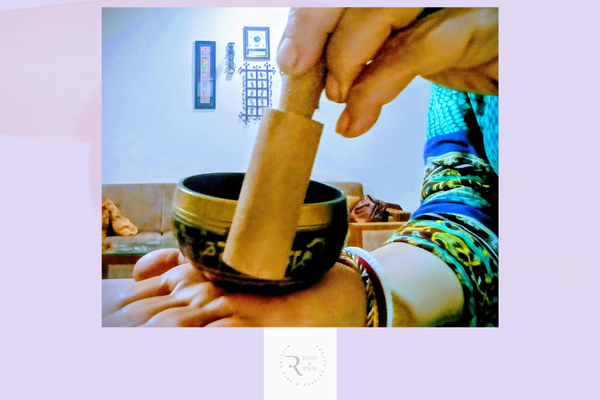
🎬Scene four. I am at the Uiversity of Rhode Island on an exchange program . We are attending a session at the URI Center for Nonviolence and Peace Studies, conducted by Thupten Tendhar, (a Geshe, or doctor of Buddhist studies). He gives us a topic for discussion. While we are busy exchanging ideas in groups, suddenly everybody’s attention is drawn to a deep, rich, resonant sound. Discussion stops. We all turn to find out the source of the deep, pulsating hum. I notice that on the left corner our trainer is tracing the rim of the bowl with the mallet. I am so fascinated with the sound and its effect that I decide I’d also use this tool when I conduct teacher training sessions.
Such is the calming effect of music on mind. Studies show that hosts of feelgood chemicals, like dopamine, oxytocin, serotonin are released when we listen to or play some soothing music. 🍃
Next post shares strategies how music can be used as an educational tool to achieve pedagogical goals.
🌄 I wake up in time to catch the glimpse of the rising sun. I like to behold the ruddy sky in the east. Then i sit or lie down calmly thinking my thoughts. When I’m done I’ll stretch and sit for my Pranayam.🪷 I lie down some more listening to my favourite songs by Pt Jasraj, Kumar Gandharv, Begum Akhtar or whichever song has me under its spell at that moment. I play that again and again. ♫
No chores please! And no plans either!
📚I then pick some books and my kindle too. Those are at the hand so I lift them without having to get up. Surrounded by the books thus, now I pick my phone check mails, messages, feed, some shopping site while books wait for me. One fine moment I’d shove it away, pick a book and immerse myself. Once in a while I pause and wonder at the beauty of thoughts and words. I doze off, read again, listen to the music and keep alternating between these.
🍂Come evening and I need to go for a long walk with a friend, we talk, exchange ideas, sit on the bench or the grass, feel the breeze, gaze up, chill some more…some writing before retiring. 😴
Oh, I didn’t say a word about meals. I don’t want to give much thought to it. Fruits, juices, soups, coffee would be fine on an ideal day. 🍍🍎🍓🍇☕⛾☕︎
Praise is a skill, not just a spontaneous utterance.It is a powerful tool in the hands of those who are responsible for children’s education and upbringing. Like all powerful tools it has to be used carefully and mindfully.
Children instinctively respond to praise. Much before their language develops they recognize praise in your smile and in your eyes. And when they sense your approval and appreciation they repeat the same act again and again. Just to please you. The right praise, offered at the right moment and in the right manner can work wonders.
I think BF Skinner did a great service to mankind by propounding Learning by Conditioning and its key concept of reinforcement. Through his experiments he showed that behaviours followed by a reward are more likely to be repeated. And praise is one such reward. A child can be rewarded in other ways too, with a gift, with a treat, but immediate praise is the most handy and effective award. If used skilfully, this tool can mould the child the way you want and you’ll find that gradually your nagging is also tailing off. So, it’s like getting double benefit, getting two-for-one. ‘Spare the rod, spoil the child’ is old school. The proverbial rod can be done away with. Punishment doesn’t bring any lasting change, instead it causes anger and hostility. Well, our focus here is not the rod, but praise and how it can be used bring desired changes in the child behaviour. Yes, Change is possible!
Which compliments would motivate the child and reinforce the desirable behaviour?
Here’s my manual on how to pack more power to praise –
✦︎What to praise?
Praise the behaviour you want to reinforce. Let’s say, you want the child to keep her things properly, or to be polite and helping to her friends in the class or to be ready on time for school. Depending on the age and developmental stage of the child, identify the behaviour you want the child to repeat.
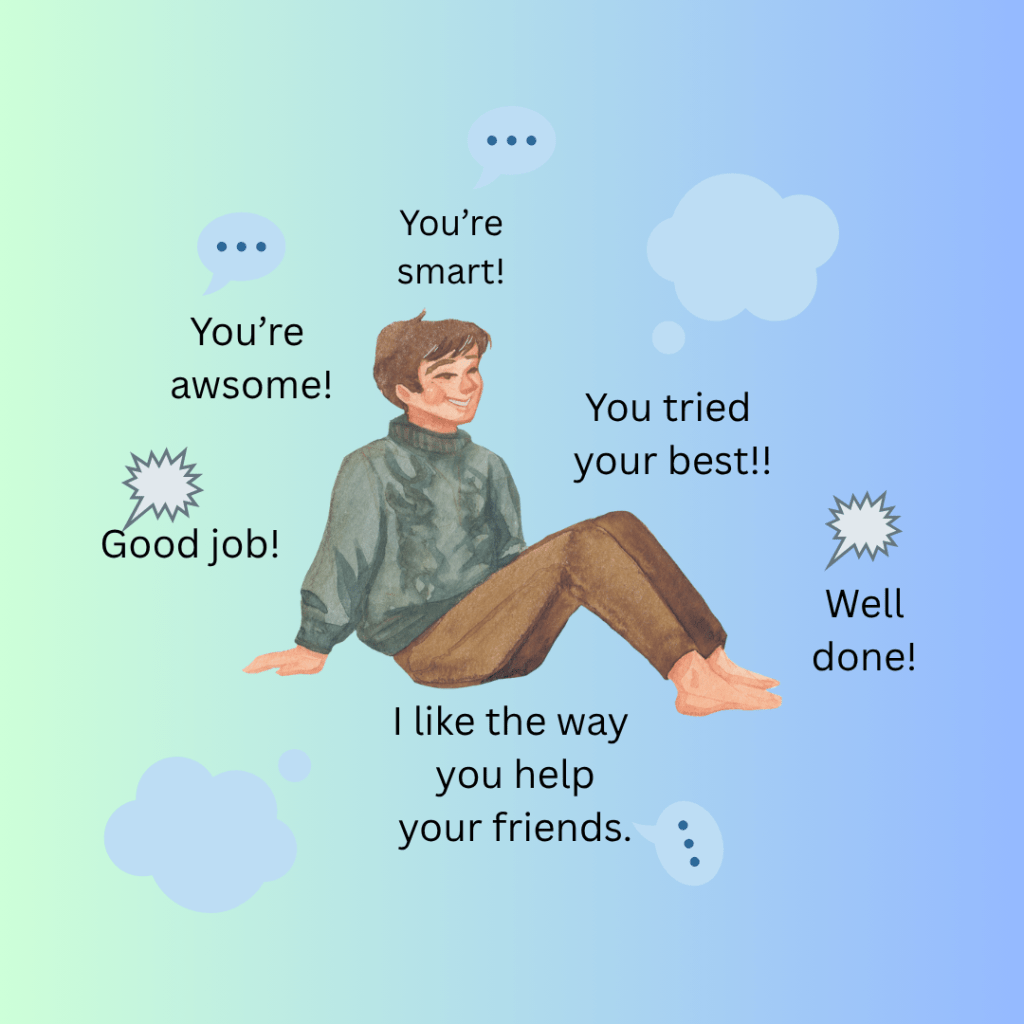
Talk to the child about the importance of a good habit/behaviour you want her to acquire. Talk, connect without being after the child about the same thing all the time, nor expect complete compliance or perfect behaviour immediately. For the sake of peace you can ignore the undesired behaviour once in a while, but don’t ignore it when the child takes even a tiny step in the right direction, that’s your opportunity, seize it. Small efforts bring big change. This is positive psychology. This is positive parenting. Be alert, catch these small steps, these small moments, and let the child know that her efforts are recognised and appreciated, ‘Today you got ready earlier than yesterday, next time try to get ready by…’ ‘I really like you are trying to be on time’ ‘your table/shelf looks tidy today. Thanks for organising it so well.’ ‘You let your friend play with your ball. That’s good.’ The smallest progress should be made a news for the child and other family members or for the class. As I often say ‘News of the difference makes a difference.’ Not just verbally, offer nonverbal praise too, smile, hug, touch, gentle look would give more power to your words.
✦︎When to praise?
As soon as you notice improved behaviour or as soon as possible. Delayed praise brings diminished returns. Sometimes for practical reasons you cannot offer praise immediately which shouldn’t be a cause of concern, take it easy. Parenting is not about perfection. You can even convey through someone else if that is possible. That also works well. Child would feel motivated when someone at home will tell her ‘Pa is pleased that you learnt your lesson all by yourself.’
I recall an incident. On one occasion my colleague conveyed my genuine praise to my 12th grade student who had lately started taking more interest in studies. While she was taking my proxy she told him ‘Renu ma’am was very happy with your work. She told me you have acquired a good understanding of the concepts and you express yourself beautifully.’ Need I tell you this communication boosted that student’s self-esteem forever and he started participating in my class more actively. It was so thoughtful my friend to communicate my genuine praise to the right person.And praise works for all children irespective of their age. It will make lasting changes in the behaviour.
✦︎How to praise?
Don’t wait for the perfect result. Don’t keep telling ‘Not good enough, try harder.’ It’s so demotivating. One statement can put the child off the track. Instead say, ‘You’re trying really hard, you’ll get there. This is how we all learn.’ Focus on effort, outcome can wait.Doesn’t The Bhagwat Gita also teach the same thing? Focus on your actions and not on the result of your actions.
•Again praise actions, behaviour, not the personality. Say ‘I like that you always talk to your elders with respect’ and not ‘you are a nice girl’ ‘you are a genius’etc.
•The more specific the praise, the more effective it will be in reinforcing the desired behaviour.
•Let non verbal praise complement your words of praise.
✦︎How much praise is good and how much is too much?
If your praise is genuine and sincere, it can’t possibly be too much. It would be just right. According to Alan Kazdin, a Yale professor and Director of Yale Parenting Centre ‘You might be concerned about praise spoiling the child. But both research and clinical experience suggests this is not really an issue.’ He further adds that we are not likely to praise too much because of our negativity bias which means our tendency to look for what is wrong.
🚦A word of caution here:
Heaping the child with compliments for nothing particular will do more harm than good. Also, use praise for reinforcement, not for coaxing and manipulation.
Thus, praise is a skill and a very crucial onefor parents and educators to acquire in order to modify children’s behaviour and inculcate growth mindset in them.Developing this skill involves continuous practice and refinement.
🗪 I’d love to know what’s your take on this subject? Leave your thoughts in the comment box.


 Roots n Wings