Tag: life lessons

  • Trust Your Transformation

    Daily writing prompt
    Jot down the first thing that comes to your mind.

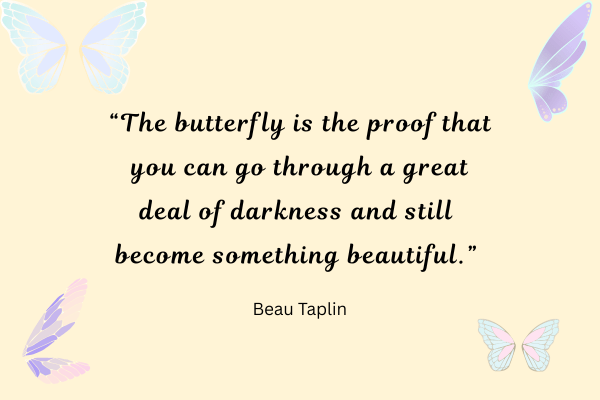
    The first thing that comes to my mind as I read this prompt is a quote I stumbled upon this morning—

    It instantly brought someone to my mind. Someone going through a difficult time, nursing a heartbreak, weighed down by disappointment, struggling to move forward through the negativity.

    I shared this thought with her, hoping it would remind her that even in the darkest phases, something meaningful is possibly taking shape beneath the surface.

    We often celebrate growth when it’s visible—when the transformation is complete. But we rarely talk about the in-between: the confusion, the self-doubt, the negativity, the waiting…

    Research in positive psychology supports this unseen phase of growth. The concept of post-traumatic growth, introduced by psychologists Richard Tedeschi and Lawrence Calhoun, suggests that people can experience profound personal development after adversity. It’s not the pain itself that transforms us, but the way we process, reflect and rebuild. 🤍☁️🌿🍃✨️

    And yet, while research gives us language for this transformation, living through it is messy.

    And it’s not just about heartbreak. It could be any loss, any setback, any moment where life feels heavier than usual. These are the times when faith feels fragile and hope feels elusive—but they are also the moments that shape our better version.

    Growth happens in the dark too! Save this for difficult days when it feels overwhelming. ⋆.˚🦋༘⋆

    🌸Let‘s connect on👇

    Instagram

  • The Learning Mindset: Finding Wisdom Everywhere

    ꜛ The above quote resonates deeply with me. It suggests a powerful yet simple idea: we can learn something from everyone we meet. The only requirement is where we choose to place our focus. If we train ourselves to notice strengths, qualities, and positives in others, every interaction becomes an opportunity for growth, IF, if we “have a heart that watches and receives” (expression borrowed from the great english poet William Wordsworth)

    ›This way of thinking closely aligns with the essence of positive psychology—a strength-focused approach. What we focus on grows. If we train our eyes to see gems, the world begins to feel richer, wiser, and more generous.

    › At the same time, learning is not just about others—it is about our willingness to be taught. If you are truly willing to learn, every experience and interaction—whether positive or negative—holds a lesson. But for that, one must be teachable. When we cultivate that openness, the entire universe becomes our teacher.

    ›In his poem ‘The Tables Turned’ William Wordsworth captured this beautifully when he wrote, “Let nature be your teacher.” He believed that:

    One impulse from a vernal wood
    May teach you more of man,
    Of moral evil and of good,
    Than all the sages can.

    ∗(From: The Tables Turned) These lines remind us that wisdom is woven into the world around us.

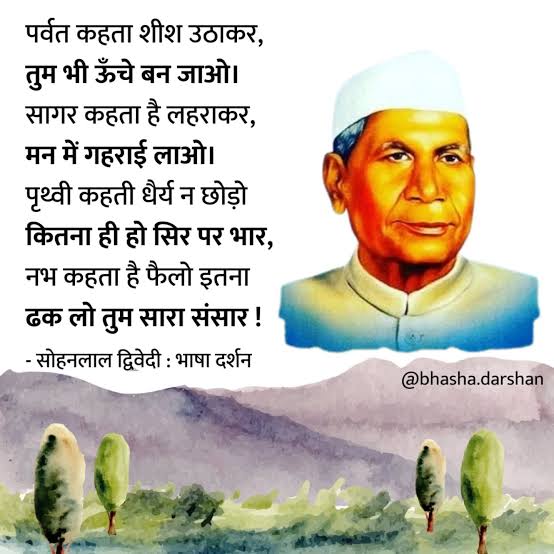
    ››As I write, I’m reminded of a poem I encountered in school, probably in the fifth grade. At that age, perhaps we are too young to fully grasp its depth, yet the message quietly stays with us. Meaning unfolds, as we grow. The image below is found on the internet.

    ››I sum up the main idea that the poem conveys. It draws lessons from nature in the most beautiful way. The mountain, standing tall and firm, teaches us to hold our heads high—to be grounded, resilient, and unwavering in our values. The ocean, vast and deep, reminds us that our thoughts, too, should have depth, encouraging us to think critically rather than remain superficial.

    ›The earth, patient and enduring, teaches us to carry our responsibilities without complaint. And the sky, limitless and expansive, inspires us to grow beyond boundaries—to embrace a perspective wide enough to include the whole world.

    🎯The poem is really about developing essential life skills.🪴 It speaks of courage—the courage to stand for what is right. It nurtures assertiveness, resilience, and the ability to think deeply. It encourages problem-solving and thoughtful decision-making. And above all, it fosters empathy—the kind that allows us to consider every soul on this planet.

    ›Perhaps the lesson is simple yet profound: if we are willing to learn, teachers are everywhere. In people. In experiences. In nature. In life itself. 🌿⚘.⋆🍃༄

    ✍️ Over to you: What’s your take? Share your thoughts in the comments below! 💬

    🌸Let‘s connect on👇

    Instagram

    Facebook

  • Make Space for Happiness

    ── ⋆⋅☆⋅⋆ Write your injuries in dust, your benefits in marble. ⋆⋅☆⋅⋆ ── Benjamin Franklin

    🧠The above quote contains a wealth of wisdom and the essence of strength-focused positive psychology.

    ๋࣭⭑Before I discuss the above aphorism, I’d like to draw your attention to a piece of information related to neuroscience. In 2005, the National Science Foundation published an article regarding research about human thoughts per day. The average person has about 12,000 to 60,000 thoughts per day. Of those 95% are exactly the same repetitive thoughts as the day before and about 80% are negative. (Source: 22 Facts About the Brain By Julia Burket)

    ๋࣭⭑Two points need highlighting.⭑One, most of our thoughts are repetitive. ⭑⭑Two, most of our thoughts are negative. So, choosing happiness would mean a mindshift and being aware of our thoughts. In the light of the above facts the advice that Franklin offers holds significant merit. Let’s analyse what advice does this aphorism offer.

    ๋࣭⭑The first part suggests ✦ ‘Write the injuries in dust.’── .✦ What will happen if we do so? The sand of time would heal our wounds. Just as no mark, however deep, made on the sand stays there for long, our wounds will also heal soon if we let them. The past can only hurt as much as we let it. And we let it by not making a conscious effort to stop our repetitive thoughts about the painful past. If we don’t cling to our hurtful experiences and  let go of hurt, it can be easily erased like writing in dust. The basic idea is that we should not allow grudges or offenses be permanently stored in your mind or heart. 🌿

    ๋࣭⭑Write ✦Your benefits in marble ── .✦This part of the quote encourages us to remember the kindnesses, blessings, and good deeds we receive and cherish eternally. We should treasure good things. We should dwell on the happy experiences a little more, a little longer. The memory of positive events creates positive emotions that’s why those memories should be permanent like etching on marble.

    ๋࣭⭑How do we write our benefits in marble? Positive psychology answers. Practice gratitude. This would redirect our repetitive thoughts in the positive direction. To quote Martin Seligman Happy people remember more good events than actually happened, and they forget more of the bad events. Depressed people, in contrast, are accurate about both── .✦ If we hold on to the good things in life, remember them often and treasure happy memories forever, it would be ike a benefit etched in marble which cannot be erased. 🍃

    ๋࣭⭑Do you see, that the quote above so completely aligns with the core ideas of rather modern positive psychology.ᐟ.ᐟ It was actually written in 18th C .ᐟ.ᐟ The point I’m trying to make is that positive psychology existed even before it came recognised as a subfield of psychology (1998)! Psychology itself became its own discipline only in late 19th C when the first psychology laboratory was opened in Germany!And it shouldn’t surprise us as gravity existed even before Newton gave it a name and the theory that Gravity is the force by which earth or other planets attract objects. 💡

    About Benjamin Franklin to whom the quote belongs. He is known as one of the founding fathers of the United States of America, lived in 18th C. He was a writer, inventor, stateman, publisher and a philosopher. He wielded great influence on American psyche at the time when social influencer were not known.

    🎤Over to you. Share your thoughts in the comments below!

    🌸Let‘s connect on👇

    Instagram

    Facebook