Tag: family

  • The Power of Praise

    Praise is a skill, not just a spontaneous utterance. It is a powerful tool in the hands of those who are responsible for children’s education and upbringing. Like all powerful tools it has to be used carefully and mindfully.

    Children instinctively respond to praise. Much before their language develops they recognize praise in your smile and in your eyes. And when they sense your approval and appreciation they repeat the same act again and again. Just to please you. The right praise, offered at the right moment and in the right manner can work wonders.

    I think BF Skinner did a great service to mankind by propounding Learning by Conditioning and its key concept of reinforcement. Through his experiments he showed that behaviours followed by a reward are more likely to be repeated. And praise is one such reward. A child can be rewarded in other ways too, with a gift, with a treat, but immediate praise is the most handy and effective award. If used skilfully, this tool can mould the child the way you want and you’ll find that gradually your nagging is also tailing off. So, it’s like getting double benefit, getting two-for-one. ‘Spare the rod, spoil the child’ is old school. The proverbial rod can be done away with. Punishment doesn’t bring any lasting change, instead it causes anger and hostility. Well, our focus here is not the rod, but praise and how it can be used bring desired changes in the child behaviour. Yes, Change is possible!
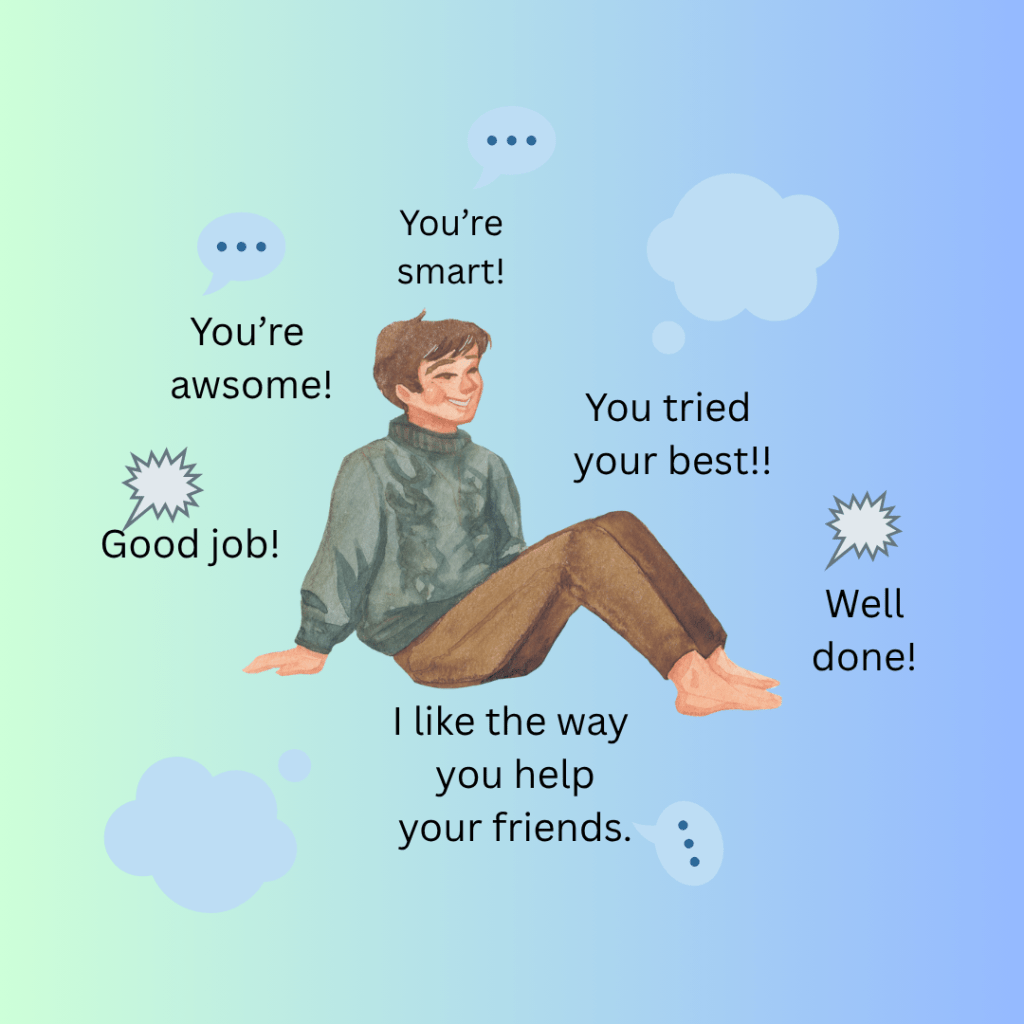
    Which compliments would motivate the child and reinforce the desirable behaviour?

    Here’s my manual on how to pack more power to praise –

    ✦︎What to praise?

    Praise the behaviour you want to reinforce. Let’s say, you want the child to keep her things properly, or to be polite and helping to her friends in the class or to be ready on time for school. Depending on the age and developmental stage of the child, identify the behaviour you want the child to repeat.

    Talk to the child about the importance of a good habit/behaviour you want her to acquire. Talk, connect without being after the child about the same thing all the time, nor expect complete compliance or perfect behaviour immediately. For the sake of peace you can ignore the undesired behaviour once in a while, but don’t ignore it when the child takes even a tiny step in the right direction, that’s your opportunity, seize it. Small efforts bring big change. This is positive psychology. This is positive parenting. Be alert, catch these small steps, these small moments, and let the child know that her efforts are recognised and appreciated, ‘Today you got ready earlier than yesterday, next time try to get ready by…’ ‘I really like you are trying to be on time’ ‘your table/shelf looks tidy today. Thanks for organising it so well.’ ‘You let your friend play with your ball. That’s good.’ The smallest progress should be made a news for the child and other family members or for the class. As I often say ‘News of the difference makes a difference.’ Not just verbally, offer nonverbal praise too, smile, hug, touch, gentle look would give more power to your words.

    ✦︎When to praise?

    As soon as you notice improved behaviour or as soon as possible. Delayed praise brings diminished returns. Sometimes for practical reasons you cannot offer praise immediately which shouldn’t be a cause of concern, take it easy. Parenting is not about perfection. You can even convey through someone else if that is possible. That also works well. Child would feel motivated when someone at home will tell her ‘Pa is pleased that you learnt your lesson all by yourself.’

    I recall an incident. On one occasion my colleague conveyed my genuine praise to my 12th grade student who had lately started taking more interest in studies. While she was taking my proxy she told him ‘Renu ma’am was very happy with your work. She told me you have acquired a good understanding of the concepts and you express yourself beautifully.’ Need I tell you this communication boosted that student’s self-esteem forever and he started participating in my class more actively. It was so thoughtful my friend to communicate my genuine praise to the right person. And praise works for all children irespective of their age. It will make lasting changes in the behaviour.

    ✦︎How to praise?

    Don’t wait for the perfect result. Don’t keep telling ‘Not good enough, try harder.’ It’s so demotivating. One statement can put the child off the track. Instead say, ‘You’re trying really hard, you’ll get there. This is how we all learn.’ Focus on effort, outcome can wait. Doesn’t The Bhagwat Gita also teach the same thing? Focus on your actions and not on the result of your actions.

    Again praise actions, behaviour, not the personality. Say ‘I like that you always talk to your elders with respect’ and not ‘you are a nice girl’ ‘you are a genius’ etc.

    The more specific the praise, the more effective it will be in reinforcing the desired behaviour.

    Let non verbal praise complement your words of praise.

    ✦︎How much praise is good and how much is too much?

    If your praise is genuine and sincere, it can’t possibly be too much. It would be just right. According to Alan Kazdin, a Yale professor and Director of Yale Parenting Centre ‘You might be concerned about praise spoiling the child. But both research and clinical experience suggests this is not really an issue.’ He further adds that we are not likely to praise too much because of our negativity bias which means our tendency to look for what is wrong.

    🚦A word of caution here:

    Heaping the child with compliments for nothing particular will do more harm than good. Also, use praise for reinforcement, not for coaxing and manipulation.

    Thus, praise is a skill and a very crucial one for parents and educators to acquire in order to modify children’s behaviour and inculcate growth mindset in them. Developing this skill involves continuous practice and refinement.

    🗪 I’d love to know what’s your take on this subject? Leave your thoughts in the comment box.

    🌸Let‘s connect on👇

    Instagram

    Facebook

  • Watch- Think

    A social commentary, a study of adolescent mind and behaviour or a message for parents, Adolescence, a British television psychological crime drama, a Netflix mini-series has it all. It was released in March 2025 and caught global attention right away.

    Well, I’ll not be a spoiler and will try to divulge only what I have to for the context. My purpose is to draw reader’s attention to its message which is relevant, not just for western society where the story is set and the series is shot but for all people. After all we are living in a global village. And as it is, when it comes to adolescent psychology and parenting the boundaries don’t exist.

    The context, Episode 1 – Crime has already taken place, and police breaks into the house of Millers as Jamie, a boy of 13 is the main suspect. ‘That’s not possible’ thinks the family and thinks the audience. Both are assured that the child will be acquitted after the interrogation and the court proceedings.

     The problem, Episode 2 & 3 – The thriller plot is lost soon. Soon both the family and audience learn it’s no mystery. Police have all the evidence. So quite early the film becomes a social commentary and a study in psychology. While the children are being investigated at school we get a glimpse of their behaviour, how aggressive, violent, and rebellious they seem and how out of sync their parents seem to them. There is a clear disconnect. The audience comes to know of the role played by the social media in the entire crime drama, how they are labelled and how it hits them. It’s on social media children get bullied, isolated or feted. This part includes the psychological assessment of the child to explore what could have motivated him to crime.

    The last episode, the 4th – offers no solution but something deeper. This part contains the message for all of us. It showcases the Miller family’s attempts to cope with the situation, their trauma, their social isolation and their failed bid to put up a brave front. It is the reality it presents that calls for serious scrutiny and thoughtful deliberation.

    The final message comes toward the end when the dejected parents analyse where they faltered. They realize they have been simple and hardworking people, amazing mom and dad. Dad,who never hit his children though his own father thrashed him a lot when he was young. They wonder how they could have raised a criminal. They search a little deeper and find out that they allowed their son too much of unsupervised screen time. They recall the time when their son was younger and used to create nice things but then they let him be with his phone and computer inside the closed room and thought he was safe there. Finally, they both admit that it was their failing. They ‘should we have done more though?’ After holding themselves responsible for the family’s fate, they look at their very nice and understanding daughter and the father asks his wife ‘How did we make her?’ and the mother answers half smiling and half crying ‘The same way we made him‘. And in the last heartbreaking scene the father breaks down and apologises ‘I’m sorry son, I should have done better.”

    The series resonated with audience all over the world. It kind of shook the world to the reality. It was a wakeup call to parents to connect to their children. Adolescents still need them. Parents should be aware of what’s going on in their child’s life. What social influences they find themselves under. British Prime Minister, Keir Starmer, met the makers of the show and made the screening of this mandatory in schools to combat toxic online culture. But I feel all parents should watch it and be watchful to keep their children from falling prey to the dark side of social media.

    Don’t say this does not concern us. This concerns anyone who has any role in bringing up the children. Often similar incidents are reported in the news papers from different parts of India. You may check the link here

    Children are not mature enough to decide what and how much social media consumption is good for them, where they should stop. They need supervision. Parents have to be observant and notice any change in their children’s behaviour and try to get to the cause of it. All parents love their children but that’s not enough. That parents are simple and hard working will not ensure that their children would also be so. No. Parents lived in a different age, their social influences were not the same as those of children today. Parents are the major influence on the children but there are other influences at work too. And the biggest influence on the adolescents is peer influence.

    To wrap it up, I’d reproduce a proverb I have heard from my mother often. I’ll transliterate it for you, ‘Raising kids is like boiling milk. Keep a steady eye, you blink and it flows out.’

    One mindful moment at a time – see you soon!

    What do you think about the post? Do share your thoughts in the comment box.

    Follow us here:

    Instagram

    Facebook

  • My Why & Your Why

    Well, Your Why’ first!

    Before I get into the ‘Why’, allow me a moment to expand on ‘You’. ‘You’ means- parents, not just biological parents, but all those who are into child rearing whether professionals or family members. Since there is no clear line separating them, I consider the entire community of child and adolescent carers as one. A teacher may be a parent too, a parent may teach too and a care giver may be a family member and so on. And therefore, the content posted on Roots n Wings will be relevant to all.

    Now the ‘Why’. Why should you dive into my content?

    A fair question. Well, I’m certain your role comes with challenges which if met with innovative approaches involving critical thinking, creative thinking and self-regulation would bring better results . On how well you carry out your role and responsibilities, will depend how well the children will do throughout their developmental stages, how well they cope with stressors and how resilient and confident they become as they grow. It’s crucial for you to be aware and informed about child development and behaviour to be able to manage their quirks and tantrums, to make the child feel secure and open to share her stories with you which is equally important for the child and for the carer. This creates a healthy connection with the child which is absolutely essential for her well-being and emotional development from early childhood to turbulent teens.

    Here is ‘My Why’.

    For the well-being and healthy growth of the plant we water roots, give nutrients to the soil. Result? The plant turns into a tree strong enough to weather any storm. It not only survives, it thrives. This is what we want for our children. Same way, parents are the roots and all the microsphere around the child is the soil. And my mission is to fortify the roots and soil so that children achieve their full potential.

    A little about my credentials. I’ll not repeat what I have already shared in the opening post. But would like to add some more to it. I got several opportunities to attend trainings, both virtual and in-person, at some prestigious universities in the US which gave me ample exposure to the common global practices. Some important trainings I enumerate here- Professional Development for teacher trainer from Arizona State University and Power Skills in Classroom, which is about developing social emotional competence among children, from University of Massachusetts, Lowell. These two were virtual exchanges. Another that I attended in-person was on Service Learning at the University of Rhode Island. The last one is about serving the society by sharing the learning and I am really keen on sharing with everyone, who can actually benefit from me and can further transfer the benefits to the younger generation. Just to set off a cascading effect!            

    I can’t sign off without a word on Positive Psychology, which is the cornerstone of Roots n Wings. I plan to talk at length about the same in my next post. For now, I’d only say that Positive Psychology focuses on strength, positive emotions and factors contributing to life satisfaction. Lastly, I want to add that content shared will always be based on scientific researches and studies in the field.

    One mindful moment at a time – see you soon!

    Do share your opinion in the comments.

    Follow me here:

    Instagram: Roots n Wings

    Facebook: Roots n Wings