That Teacher’s Day, Arvind, my eighth-grade student, taught me a lesson in empathy.
Teacher’s Day is a special day in schools. As part of a much-loved tradition, students take over the roles of the adults who keep the school running. They become teachers, principals, supervisors, administrators, and members of the non-teaching staff. They plan, organise, manage, and carry out the many little tasks that usually happen quietly in the background.
Students love it. Teachers are amused. And, for one day, we get to feel a little pampered.
Arvind became the peon for the day. He took his role seriously, trying to carry out his duties efficiently. He ran errands, carried registers from one place to another, and was constantly on the move.
The next day, when my class gathered, I asked the students who had taken on different responsibilities to reflect on their experiences and share them with the class.
Most of them said they enjoyed themselves. It was fun to step into someone else’s role for a day.
Then Arvind spoke…What he said made me pause….၊၊||၊
❛ Yesterday I realised how tough Sanjay Bhai’s job is. He has to be on his toes all the time to make sure our classes and exams run smoothly, and we never even realise it.❜
I was touched.
While most of the children had experienced the day as an enjoyable activity, Arvind had experienced something more. For a brief moment, he had stepped into someone else’s world. He had felt the demands of a job he had probably never thought much about before.
And that made me wonder: Isn’t this what empathy is?
Sometimes, we understand another person not by being told what they feel, but by experiencing what they go through.
We talk about teaching children empathy. We tell them to be kind, considerate, and understanding. But perhaps some of the most powerful lessons in empathy come not from what we tell children, but from the opportunities we give them to walk in someone else’s shoes.
🔖Before you judge someone, walk a mile in their shoes. ๋࣭ ⭑ ๋࣭ ⭑
This old adage is all about empathy and I wish to expand it a bit. Before you heckle, harass, bully, insult, isolate or deride someone imagine yourself in their place. All the violence, conflict, poverty, corruption that we see around or read about stems from lack of empathy. Violence arises when we lose the ability to see others as individuals, when we fail to understand other people’s perspective and feel their pain.
✧˖ Therefore, to create harmonious and peaceful world society needs to be sensitized. We need to foster empathy, the ability to be aware of the feelings of others and imagine what it would be like to be in their position. Empathy lays the groundwork for positive relationships, and self awareness and social awareness are the primary requirements for kindling empathy.
✧˖ Fostering empathy is the ultimate antidote to violence. But who will do this? On whom lies the great onus? Like everything else this should also begin from home. Herein comes the role of us adults, greater responsibility is on teachers and guardians.
✧˖ Let’s see, ‘Can empathy be taught like a branch of knowledge? Can empathy be learnt like a skill? Or can empathy be passed as a piece of information?’ ‘No’. Empathy is neither knowledge, nor skill nor information. It is the matter of heart, feelings, sensibilities. Empathy can be stirred, fostered, nurtured in children.
➤ Given below are some of strategies that can be used effectively at home and schools for modelling and developing empathy over time. These strategies are more effective if fine-tuned according to the child’s age:
»The thumb rule is we should model whatever qualities we want to inculcate in children. So first step is to show empathy to children and how do we show it? By listening to them, by trying to see their points of views and by not dismissing their emotions.
»Discuss emotions with them. Ask how they are feeling, what bodily sensations they when they have big emotions. You may share your own emotions using I statements.
»📚Stories and pictures offer great opportunities to discuss emotions. There are several stories that can stir empathy, can move one, for instance stories written by Hans Anderson, Munshi Premchand, Charles Dickens, O Henry, Leo Tolstoy to name a few. We can take age appropriate stories and discuss how those characters feel in certain circumstances. For younger kids pictures can be used for discussing emotions so they can relate emotions to facial expressions and posture. This helps them understand other people’s feelings and emotions better. 😊😔🥹
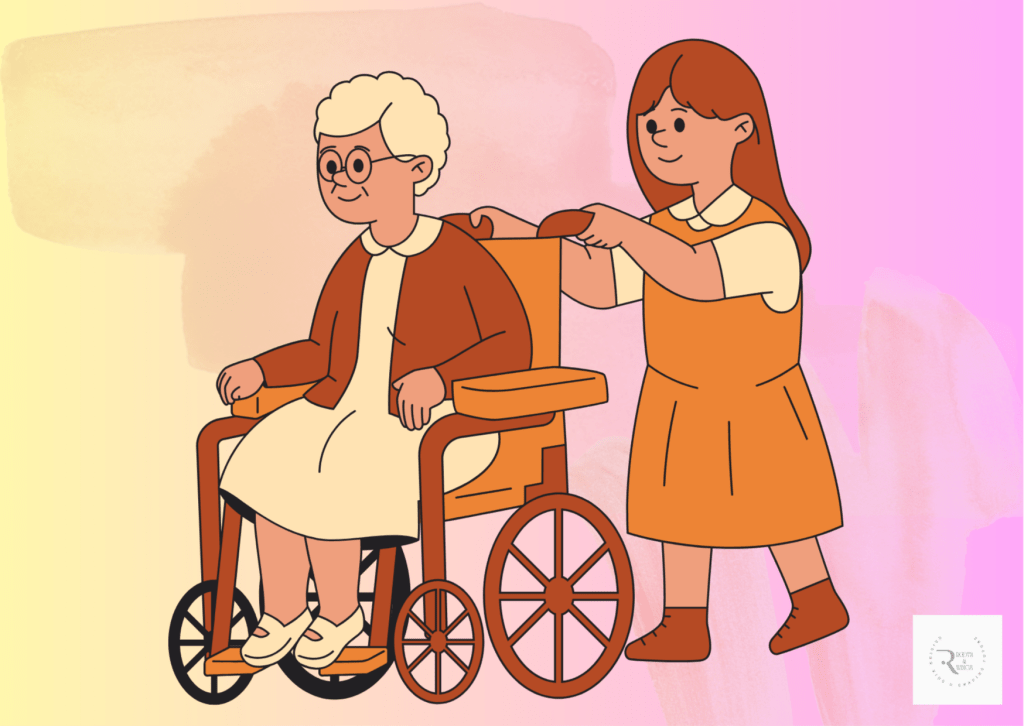
»Then, role play can be used in classrooms to activate empathy in children. Role play is actually, rather virtually putting one in someone else’s shoes. Role play can be used for embracing diversity, for understanding other people’s problems, behaviours, needs or viewpoints. Playing the role of someone differently abled or from different backgrounds or different age groups is a nice way to understand them. I’ll give two incidents that show how role play works up empathy. 🎭
On the Teacher’s Day, September 5th students run the school, they get into the roles of all the teaching and non-teaching staff and admin, as is the common practice in our country. One of my eighth graders, who was assigned the role of the peon for the day shared with the class later ‘This was the first time I realized how much work and responsibility the school peon carries every day. How hard his job is and how helpful he is for us.’ It was an important message. Apart from empathy, it also taught something about the dignity of labour.
In another example, my class of 10–11-year-olds was doing a lesson ‘A Different Kind of School’ which is about a school where Miss Beam, the principal had a unique method of teaching empathy. On certain days in the school some students were blindfolded or bandaged while other students had to help them. They did not have any disability but this was how they were to learn what it meant and how they could help others too. While doing this lesson I too suggested if we may also have similar activity and all the students welcomed the idea in one voice. And when one student did the role of a boy with an injured leg others were ready to offer help. And later students shared how they felt.
»Discussing news events, when children are old enough to discuss these, is another effective way of activating empathy. For example, the event I discussed in my previous post may make them more inclusive and more understanding. They may realize that people who are different from them too have their rights and they too have similar feelings and emotions and should be respected as such. The news gives enough opportunities to discuss issues like equality, justice, diversity, humanity etc.
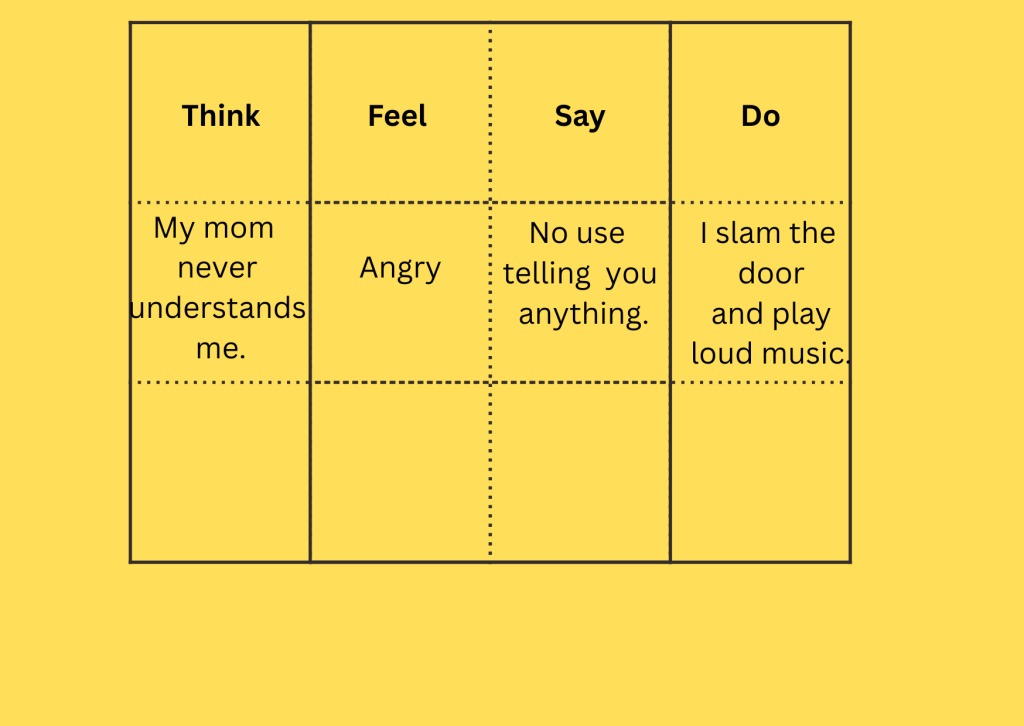
»In order to discuss emotions children may be shown the table to complete. Table with columns think, feel, say, do, as shown below. This can be adapted according to their ages. Younger ones can do with the help of emotion chart. older ones can do it through stories, pictures, characters, news. This makes them self aware and socially aware as well.
»Lastly, just as I said in the beginning that we should model the quality that we want to see in children there is another rule that we should praise the qualities we want to see in children. So whenever children show empathetic behaviour do praise them and praise specifically what action you really appreciate whether they helped someone, whether shared their tiffin or toys with friends or just sat with someone who was lonesome.
In my opinion, if we are able to instil empathy at an early age, we empower the next generation to build a safer and more compassionate world.