I look for meaning in small everyday experiences. Here are a few ordinary moments that have stayed with me.
⋆˙⟡ It was my English class of ninth graders. We were practicing simple present tense. The students had to describe someone’s daily routine. One student chose her father.
“When my father wakes up he first checks his phone for half an hour. He gets ready, takes breakfast. Sometimes during breakfast he watches reels . He leaves for work at 9:30 morning and comes back at 6:30 pm. He has tea with my mother and they watch TV for an hour. When my mother cooks dinner, he watches news. He goes to sleep at 12 and before that he likes to play video games.”
That was the routine!
She wasn’t complaining. She was just describing… normal life.
⋆˙⟡
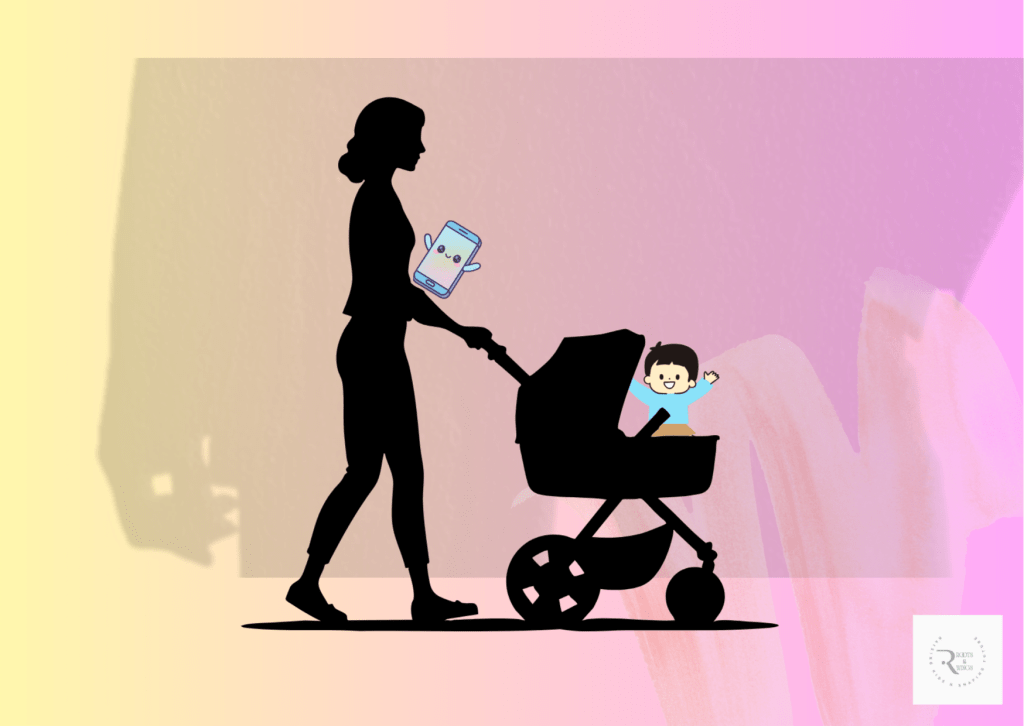
🍀Now shift to a park in my neighbourhood. I’m just people watching from a distance. A woman takes the kid out on a stroller. There are trees there are flowers, and maybe butterfies. There’s a pond nearby and a playground. The child sits comfortably and takes in all that she can. The woman is pushing the stroller with one hand on autopilot and her other hand holds the phone, which in turn holds all her attention.
🌀I begin to turn it over in my mind and think while the child is actively navigating her world, that woman who could be a mother or a caretaker is losing a key moment to connect.
⋆˙⟡
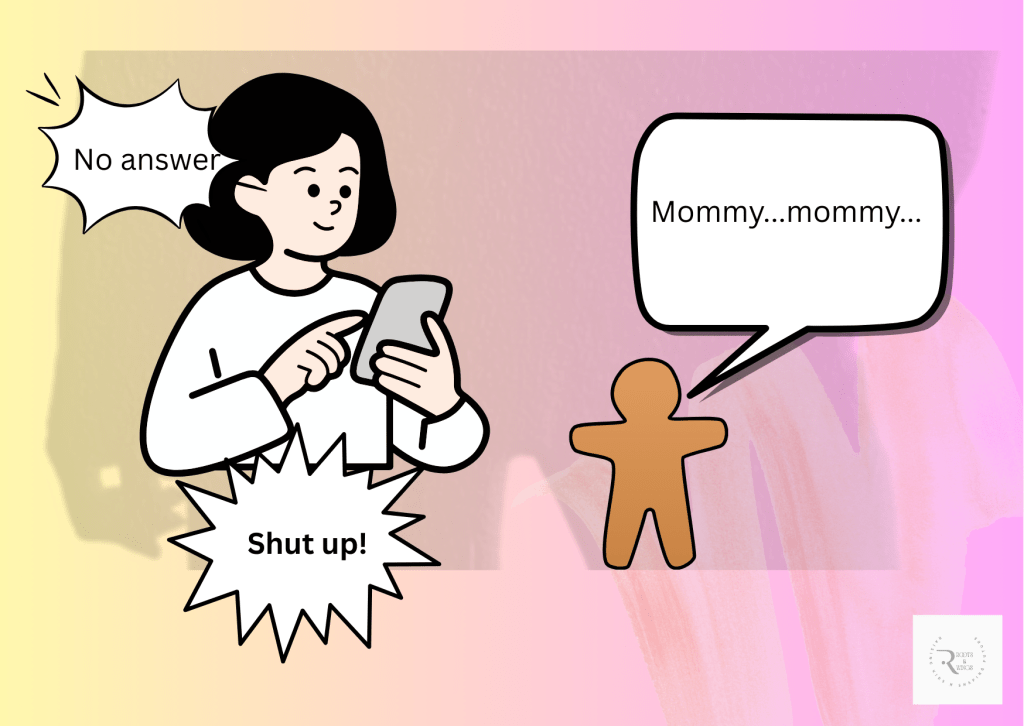
🎞️Now picture this. A mother immersed in the device in her palm.
The excited kid calls ‘Mommy…..mommy!’
No answer.
Mommy!
‘WHAT ⁉️’
N..nothing 😦
Child withdraws.
⋆˙⟡ Pause for thought. ᝰ.ᐟ
In all the three real life moments what message are the adults giving to the children?💬 If we don’t form meaningful connection with kids, how will kids share their feelings with us. Then there’s no point complaining that kids don’t listen to us.
🧩Parenting is not about perfection, it’s about connection. It’s not about eliminating screens, but being present for children. Maybe it begins with one small pause —with eye contact and one fully present moment.
In my next post, we’ll explore the often unnoticed power of modelling in parenting.
🗝️Three key areas where music can be used as an educational tool: ‣Classroom management; ‣Memory, retention and ‣concentration; Community building.
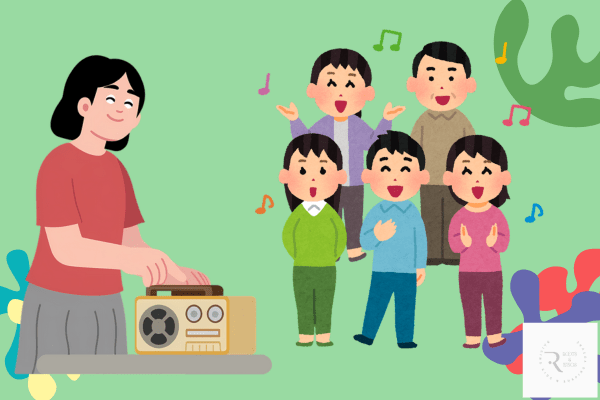
✧My previous post recounted some moments that revealed the magical effect of music on mind, on mood. If music can regulate emotions, reduce anxiety, build bonds, improve focus, then it definitely is a powerful tool for the social emotional development of children which in turn will sharpen their cognitive abilities and boost academic performance.
👉Here I share strategies for making intentional use of music in classrooms for better teaching learning experiences. These strategies are drawn from my personal reflections and practical insights based on myown teaching experience, my experience as a teacher trainer and from observing other colleagues:
⚡Classroom management- Morning assembly prayer and songs is a common routine in most schools that makes the students and teachers fresh, energetic to start the day with positive vibes. ⬩However, teachers would agree that the transition from one period to another, when one teacher leaves and the other enters or students move from one classroom to another, is always full of chaos and commotion.
⬩ In one of the schools I observed, instead of ringing piercing bell they play a Mozart Symphony or some instrumental music, to signal the end of one subject period. This, I realized, minimized the noise and chaos during transitions effectively.
⬩Tasks can be timed with music. Students work on the task till soft music continues and stop activity/exercise the as the music stops.
⬩For signalling- for better management some sound signals can be created to signify instructions like tidying up the room, filing out or for being quiet. Rainstick or some chimealso is useful.
⚡For memorizing- Music strengthens memory. For younger children, it is effective way of acquiring linguistic skills, and a very potent tool for memorizing as they repeat the same songs, poems often.
⬩Improving focus – Soft music helps concentrate so can be used in the classroom while students are at a writing task or drawing or reading silently. Teachers will have to check the volume which should be very soft and low so it does not itself become a distraction.
To improve focus if the students come back to their classroom after recess or sports period make them sit for two minutes with eyes closed while some soft music plays and they open eyes when th e music stops.🌱
⬩Music can come handy as a brain break activity. It has now been established through studies that brain breaks boost attention spans. Introduce 5 minutes activities every 25 minutes to refresh minds. And after breaks students returned ready to learn. 👩🏻💻📓✍🏻💡
⚡For Community building- Having a chant for their group or some group musical activities produce neurochemicals that energise (endorphins) and release social bonding hormone (oxytocin), thus fostering feelings of trust, connectedness among children. This community feeling is crucial for the children to feel safe and supported which is a prerequisite for better learning.
⚠️What is important is to choose music or songs keeping the age of the students in mind. Ensure that the music does not distract students from their task. Keep the music low unless the students are feeling dull and need to be energized and other classes are not disturbed.
▸Choose the strategies discreetly, overdoing reduces impact.
▸Also know your students. Through a little experimentation a teacher can find out what works with their class. Different groups have different preferences. One class I taught loved short stories over songs and I used to be on the look out for stories that I could squeeze into the lesson plan. But that’s the story for another day 😊
🔖Before you judge someone, walk a mile in their shoes. ๋࣭ ⭑ ๋࣭ ⭑
This old adage is all about empathy and I wish to expand it a bit. Before you heckle, harass, bully, insult, isolate or deride someone imagine yourself in their place. All the violence, conflict, poverty, corruption that we see around or read about stems from lack of empathy. Violence arises when we lose the ability to see others as individuals, when we fail to understand other people’s perspective and feel their pain.
✧˖ Therefore, to create harmonious and peaceful world society needs to be sensitized. We need to foster empathy, the ability to be aware of the feelings of others and imagine what it would be like to be in their position. Empathy lays the groundwork for positive relationships, and self awareness and social awareness are the primary requirements for kindling empathy.
✧˖ Fostering empathy is the ultimate antidote to violence. But who will do this? On whom lies the great onus? Like everything else this should also begin from home. Herein comes the role of us adults, greater responsibility is on teachers and guardians.
✧˖ Let’s see, ‘Can empathy be taught like a branch of knowledge? Can empathy be learnt like a skill? Or can empathy be passed as a piece of information?’ ‘No’. Empathy is neither knowledge, nor skill nor information. It is the matter of heart, feelings, sensibilities. Empathy can be stirred, fostered, nurtured in children.
➤ Given below are some of strategies that can be used effectively at home and schools for modelling and developing empathy over time. These strategies are more effective if fine-tuned according to the child’s age:
»The thumb rule is we should model whatever qualities we want to inculcate in children. So first step is to show empathy to children and how do we show it? By listening to them, by trying to see their points of views and by not dismissing their emotions.
»Discuss emotions with them. Ask how they are feeling, what bodily sensations they when they have big emotions. You may share your own emotions using I statements.
»📚Stories and pictures offer great opportunities to discuss emotions. There are several stories that can stir empathy, can move one, for instance stories written by Hans Anderson, Munshi Premchand, Charles Dickens, O Henry, Leo Tolstoy to name a few. We can take age appropriate stories and discuss how those characters feel in certain circumstances. For younger kids pictures can be used for discussing emotions so they can relate emotions to facial expressions and posture. This helps them understand other people’s feelings and emotions better. 😊😔🥹
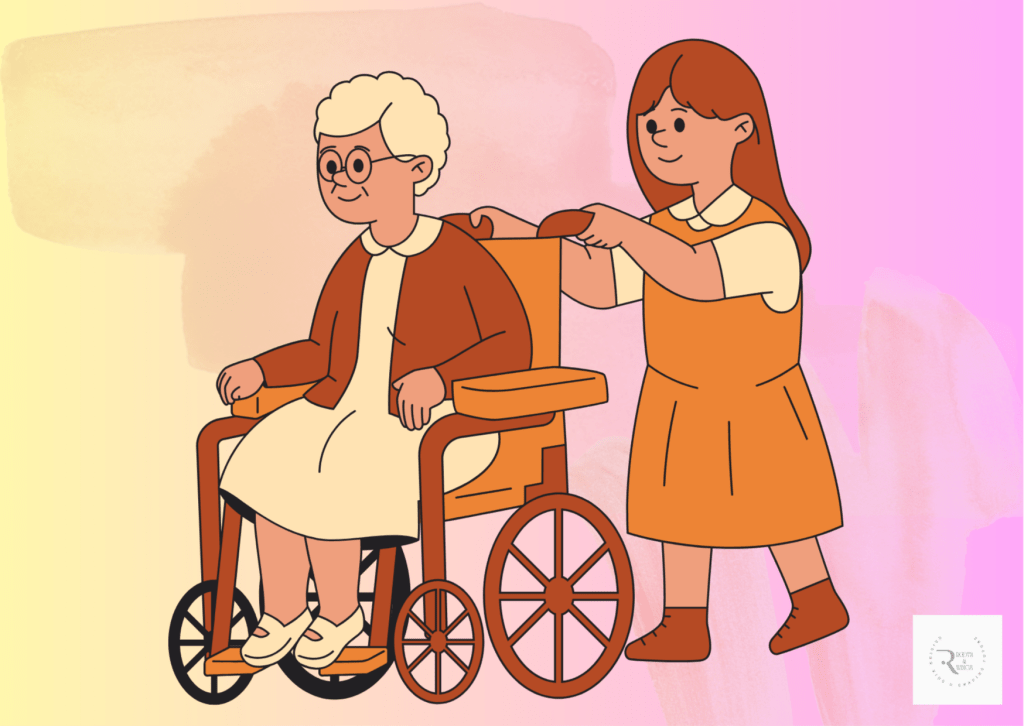
»Then, role play can be used in classrooms to activate empathy in children. Role play is actually, rather virtually putting one in someone else’s shoes. Role play can be used for embracing diversity, for understanding other people’s problems, behaviours, needs or viewpoints. Playing the role of someone differently abled or from different backgrounds or different age groups is a nice way to understand them. I’ll give two incidents that show how role play works up empathy. 🎭
On the Teacher’s Day, September 5th students run the school, they get into the roles of all the teaching and non-teaching staff and admin, as is the common practice in our country. One of my eighth graders, who was assigned the role of the peon for the day shared with the class later ‘This was the first time I realized how much work and responsibility the school peon carries every day. How hard his job is and how helpful he is for us.’ It was an important message. Apart from empathy, it also taught something about the dignity of labour.
In another example, my class of 10–11-year-olds was doing a lesson ‘A Different Kind of School’ which is about a school where Miss Beam, the principal had a unique method of teaching empathy. On certain days in the school some students were blindfolded or bandaged while other students had to help them. They did not have any disability but this was how they were to learn what it meant and how they could help others too. While doing this lesson I too suggested if we may also have similar activity and all the students welcomed the idea in one voice. And when one student did the role of a boy with an injured leg others were ready to offer help. And later students shared how they felt.
»Discussing news events, when children are old enough to discuss these, is another effective way of activating empathy. For example, the event I discussed in my previous post may make them more inclusive and more understanding. They may realize that people who are different from them too have their rights and they too have similar feelings and emotions and should be respected as such. The news gives enough opportunities to discuss issues like equality, justice, diversity, humanity etc.
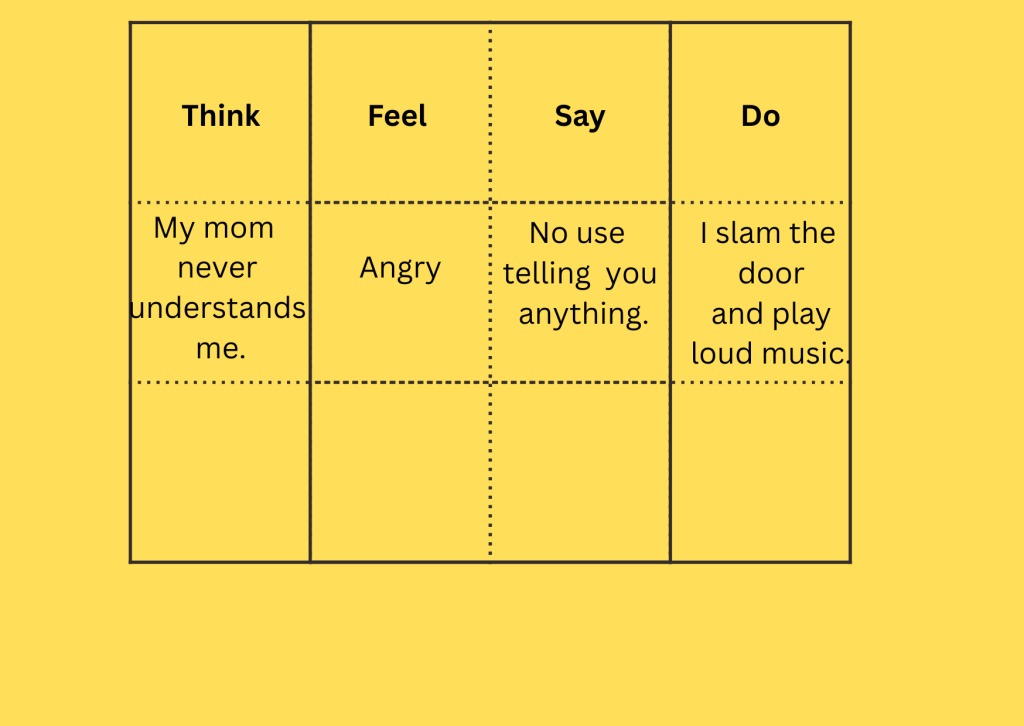
»In order to discuss emotions children may be shown the table to complete. Table with columns think, feel, say, do, as shown below. This can be adapted according to their ages. Younger ones can do with the help of emotion chart. older ones can do it through stories, pictures, characters, news. This makes them self aware and socially aware as well.
»Lastly, just as I said in the beginning that we should model the quality that we want to see in children there is another rule that we should praise the qualities we want to see in children. So whenever children show empathetic behaviour do praise them and praise specifically what action you really appreciate whether they helped someone, whether shared their tiffin or toys with friends or just sat with someone who was lonesome.
In my opinion, if we are able to instil empathy at an early age, we empower the next generation to build a safer and more compassionate world.
I was people watching while waiting for someone at the airport arrivals area. People at the arrivals generally look happy to be joined by their families and friends.They greet and hug their loved ones. They might have waited for this moment for a long time.
One such union I watched up close. It looked like a homecoming of a young man in late twenties. First the mother, so I assumed, hugged him and gave a peck on the cheek. The young man looked embarrassed being so petted by his mother like this. Then the Indian father who looked equally delighted to see his son but being less expansive in his affection gave a pat on his shoulder. Then came the younger sister who was eagerly waiting for her turn and lifted herself a little to hug her brother whose smiling face was visible to me while the girl’s back was turned towards me. At this moment I, an indifferent observer, found myself struggling to hold back my tears for I didn’t want to be seen crying and I had no reason to. As the girl released her rather longish hug and turned her face, I could see her tears while the brother and the parents smiled a tender smile.
𖡎 How did that happen? I was observing only because all this was happening where I was standing and without any special interest. Still my eyes moistened when the little sister hugged her brother, though I did not see her tears.
Were the mirror neurons firing in my brain? 🧠⚡🧠
𖡎 The teacher in me was intrigued with this behaviour. And the first thought I had was if this knowledge of mirror neurons could help teachers, parents and children. I had read about mirror neurons in Dr John Medina’s book ‘Brain Rules’, but I searched some more. This is what I learnt-
Mirror neurons are cells whose activity reflect their surroundings. Giacomo Rizzolatti, an Italian neurophysiologist and his team are credited with discovering mirror neurons. Their paper on mirror neurons was published in 1990. While performing an experiment on macaque monkeys they observed that the neurons that fired when monkeys picked raisins, also fired when they saw someone else doing the same and even when monkeys did not actually see someone doing it. Later research suggested that mirror neurons respond not so much the physical movement itself, but the intention. This explains my behaviour that day at the airport arrivals area. 🧠⚡🧠
Having understood the mirror neuron phenomenon I started wondering how that can be applied to in classrooms and home settings and how mirror neurons can support learning. ⋆。°·☁︎
🚨The first thing we have to know that there’s a mirror brain and if there is, we adults can make use of this in the classroom and home to inculcate the desired behaviour. I mean, we can use this brain behaviour to our advantage in shaping children’s behaviour. This corroborates Albert Bandura’s Social Learning Theory which emphasises imitation and modelling.
Teachers and guardians can model enthusiasm, curiosity, respect and even thinking processes by solving a problem aloud. and verbalizing thought processes. Self awareness is the key to modelling.
🚨We can teach children calm, emotional regulation, respond to signals by modelling responses intentionally and consistently. And there’s enough evidence to show that calm, secure and emotionally regulated children not only perform better academically, but are more emotionally intelligent and socially competent also.
❝Don’t worry that your children don’t listen to you, worry that they watch you ❞ This famous parenting quote does encapsulate profound wisdom. So next time you yell at children or tell them not to fritter away time online, remember the mirror brain.
Have more thoughts or tips on this? Share those in the comments below. 💭
── ⋆⋅☆⋅⋆ Write your injuries in dust, your benefits in marble. ⋆⋅☆⋅⋆ ── Benjamin Franklin
🧠The above quote contains a wealth of wisdom and the essence of strength-focused positive psychology.
๋࣭⭑Before I discuss the above aphorism, I’d like to draw your attention to a piece of information related to neuroscience. In 2005, the National Science Foundation published an article regarding research about human thoughts per day. The average person has about 12,000 to 60,000 thoughts per day. Of those 95% are exactly the same repetitive thoughts as the day before and about 80% are negative. (Source: 22 Facts About the Brain By Julia Burket)
๋࣭⭑Two points need highlighting.⭑One, most of our thoughts are repetitive. ⭑⭑Two, most of our thoughts are negative. So, choosing happiness would mean a mindshift and being aware of our thoughts. In the light of the above facts the advice that Franklin offers holds significant merit. Let’s analyse what advice does this aphorism offer.
๋࣭⭑The first part suggests ✦ ‘Write the injuries in dust.’── .✦ What will happen if we do so? The sand of time would heal our wounds. Just as no mark, however deep, made on the sand stays there for long, our wounds will also heal soon if we let them. The past can only hurt as much as we let it. And we let it by not making a conscious effort to stop our repetitive thoughts about the painful past. If we don’t cling to our hurtful experiences and let go of hurt, it can be easily erased like writing in dust. The basic idea is that we should not allow grudges or offenses be permanently stored in your mind or heart. 🌿
๋࣭⭑Write ✦Your benefits in marble ── .✦This part of the quote encourages us to remember the kindnesses, blessings, and good deeds we receive and cherish eternally. We should treasure good things. We should dwell on the happy experiences a little more, a little longer. The memory of positive events creates positive emotions that’s why those memories should be permanent like etching on marble.
๋࣭⭑How do we write our benefits in marble? Positive psychology answers. Practice gratitude. This would redirect our repetitive thoughts in the positive direction. To quote Martin Seligman ✦Happy people remember more good events than actually happened, and they forget more of the bad events. Depressed people, in contrast, are accurate about both── .✦ If we hold on to the good things in life, remember them often and treasure happy memories forever, it would be ike a benefit etched in marble which cannot be erased. 🍃
๋࣭⭑Do you see, that the quote above so completely aligns with the core ideas of rather modern positive psychology.ᐟ.ᐟ It was actually written in 18th C .ᐟ.ᐟ The point I’m trying to make is that positive psychology existed even before it came recognised as a subfield of psychology (1998)! Psychology itself became its own discipline only in late 19th C when the first psychology laboratory was opened in Germany!And it shouldn’t surprise us as gravity existed even before Newton gave it a name and the theory that Gravity is the force by which earth or other planets attract objects. 💡
✱AboutBenjamin Franklin to whom the quote belongs. He is known as one of the founding fathers of the United States of America, lived in 18th C. He was a writer, inventor, stateman, publisher and a philosopher. He wielded great influence on American psyche at the time when social influencer were not known.
🎤Over to you. Share your thoughts in the comments below!
Praise is a skill, not just a spontaneous utterance.It is a powerful tool in the hands of those who are responsible for children’s education and upbringing. Like all powerful tools it has to be used carefully and mindfully.
Children instinctively respond to praise. Much before their language develops they recognize praise in your smile and in your eyes. And when they sense your approval and appreciation they repeat the same act again and again. Just to please you. The right praise, offered at the right moment and in the right manner can work wonders.
I think BF Skinner did a great service to mankind by propounding Learning by Conditioning and its key concept of reinforcement. Through his experiments he showed that behaviours followed by a reward are more likely to be repeated. And praise is one such reward. A child can be rewarded in other ways too, with a gift, with a treat, but immediate praise is the most handy and effective award. If used skilfully, this tool can mould the child the way you want and you’ll find that gradually your nagging is also tailing off. So, it’s like getting double benefit, getting two-for-one. ‘Spare the rod, spoil the child’ is old school. The proverbial rod can be done away with. Punishment doesn’t bring any lasting change, instead it causes anger and hostility. Well, our focus here is not the rod, but praise and how it can be used bring desired changes in the child behaviour. Yes, Change is possible!
Which compliments would motivate the child and reinforce the desirable behaviour?
Here’s my manual on how to pack more power to praise –
✦︎What to praise?
Praise the behaviour you want to reinforce. Let’s say, you want the child to keep her things properly, or to be polite and helping to her friends in the class or to be ready on time for school. Depending on the age and developmental stage of the child, identify the behaviour you want the child to repeat.
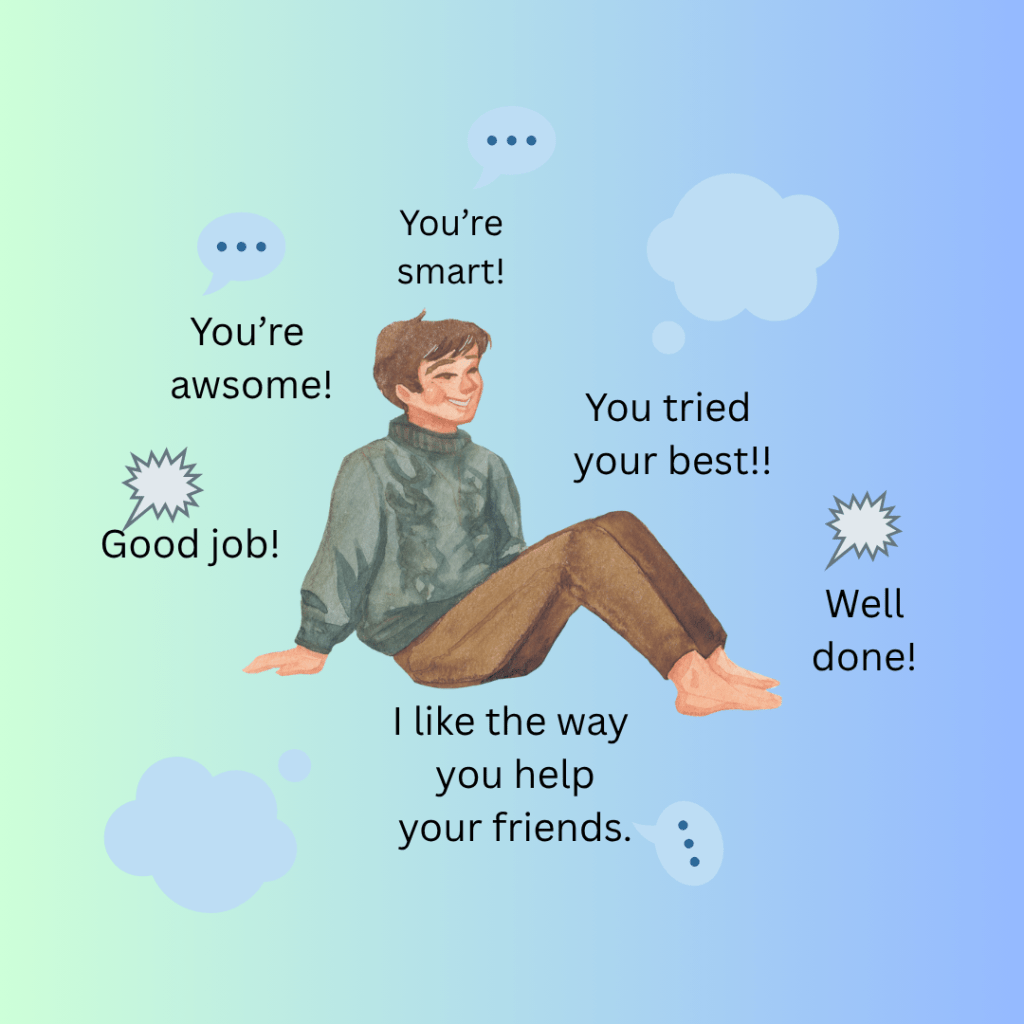
Talk to the child about the importance of a good habit/behaviour you want her to acquire. Talk, connect without being after the child about the same thing all the time, nor expect complete compliance or perfect behaviour immediately. For the sake of peace you can ignore the undesired behaviour once in a while, but don’t ignore it when the child takes even a tiny step in the right direction, that’s your opportunity, seize it. Small efforts bring big change. This is positive psychology. This is positive parenting. Be alert, catch these small steps, these small moments, and let the child know that her efforts are recognised and appreciated, ‘Today you got ready earlier than yesterday, next time try to get ready by…’ ‘I really like you are trying to be on time’ ‘your table/shelf looks tidy today. Thanks for organising it so well.’ ‘You let your friend play with your ball. That’s good.’ The smallest progress should be made a news for the child and other family members or for the class. As I often say ‘News of the difference makes a difference.’ Not just verbally, offer nonverbal praise too, smile, hug, touch, gentle look would give more power to your words.
✦︎When to praise?
As soon as you notice improved behaviour or as soon as possible. Delayed praise brings diminished returns. Sometimes for practical reasons you cannot offer praise immediately which shouldn’t be a cause of concern, take it easy. Parenting is not about perfection. You can even convey through someone else if that is possible. That also works well. Child would feel motivated when someone at home will tell her ‘Pa is pleased that you learnt your lesson all by yourself.’
I recall an incident. On one occasion my colleague conveyed my genuine praise to my 12th grade student who had lately started taking more interest in studies. While she was taking my proxy she told him ‘Renu ma’am was very happy with your work. She told me you have acquired a good understanding of the concepts and you express yourself beautifully.’ Need I tell you this communication boosted that student’s self-esteem forever and he started participating in my class more actively. It was so thoughtful my friend to communicate my genuine praise to the right person.And praise works for all children irespective of their age. It will make lasting changes in the behaviour.
✦︎How to praise?
Don’t wait for the perfect result. Don’t keep telling ‘Not good enough, try harder.’ It’s so demotivating. One statement can put the child off the track. Instead say, ‘You’re trying really hard, you’ll get there. This is how we all learn.’ Focus on effort, outcome can wait.Doesn’t The Bhagwat Gita also teach the same thing? Focus on your actions and not on the result of your actions.
•Again praise actions, behaviour, not the personality. Say ‘I like that you always talk to your elders with respect’ and not ‘you are a nice girl’ ‘you are a genius’etc.
•The more specific the praise, the more effective it will be in reinforcing the desired behaviour.
•Let non verbal praise complement your words of praise.
✦︎How much praise is good and how much is too much?
If your praise is genuine and sincere, it can’t possibly be too much. It would be just right. According to Alan Kazdin, a Yale professor and Director of Yale Parenting Centre ‘You might be concerned about praise spoiling the child. But both research and clinical experience suggests this is not really an issue.’ He further adds that we are not likely to praise too much because of our negativity bias which means our tendency to look for what is wrong.
🚦A word of caution here:
Heaping the child with compliments for nothing particular will do more harm than good. Also, use praise for reinforcement, not for coaxing and manipulation.
Thus, praise is a skill and a very crucial onefor parents and educators to acquire in order to modify children’s behaviour and inculcate growth mindset in them.Developing this skill involves continuous practice and refinement.
🗪 I’d love to know what’s your take on this subject? Leave your thoughts in the comment box.
 Roots n Wings