Category: Mindful Moments

Thoughts inspired by simple, commonplace events interpreting these through the lens of positive psychology.

  • The Power of Presence in Parenting

    I look for meaning in small everyday experiences. Here are a few ordinary moments that have stayed with me.

    ⋆˙⟡ It was my English class of ninth graders. We were practicing simple present tense. The students had to describe someone’s daily routine. One student chose her father.

    “When my father wakes up he first checks his phone for half an hour. He gets ready, takes breakfast. Sometimes during breakfast he watches reels . He leaves for work at 9:30 morning and comes back at 6:30 pm. He has tea with my mother and they watch TV for an hour. When my mother cooks dinner, he watches news. He goes to sleep at 12 and before that he likes to play video games.”

    That was the routine!

    She wasn’t complaining. She was just describing… normal life.

    ⋆˙⟡
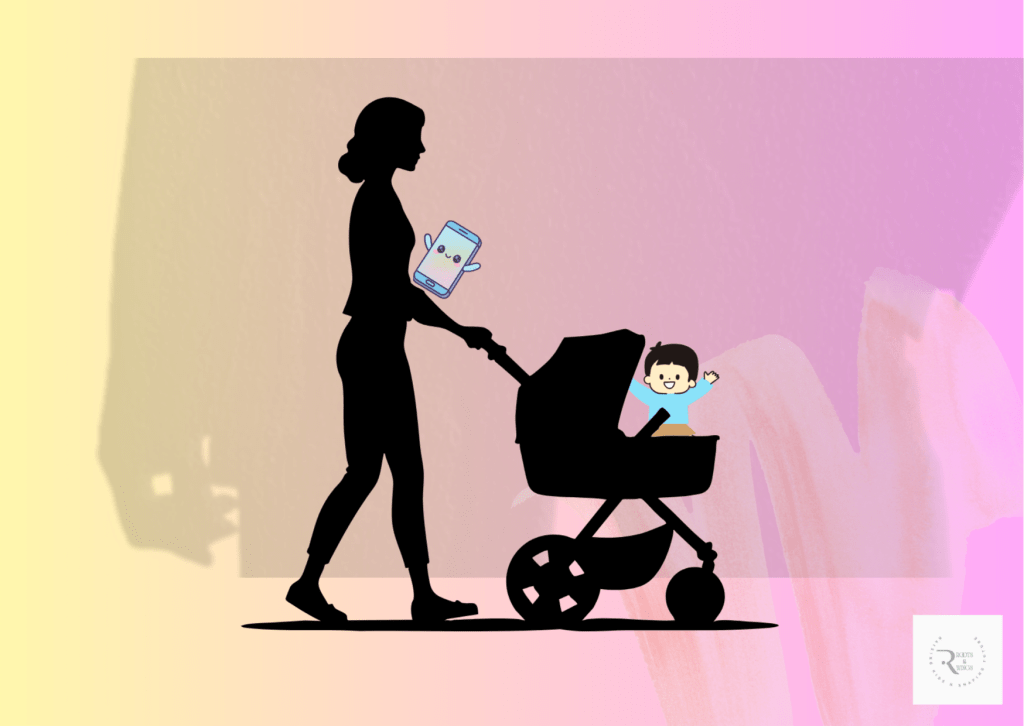
    🍀Now shift to a park in my neighbourhood. I’m just people watching from a distance. A woman takes the kid out on a stroller. There are trees there are flowers, and maybe butterfies. There’s a pond nearby and a playground. The child sits comfortably and takes in all that she can. The woman is pushing the stroller with one hand on autopilot and her other hand holds the phone, which in turn holds all her attention.

    🌀I begin to turn it over in my mind and think while the child is actively navigating her world, that woman who could be a mother or a caretaker is losing a key moment to connect. 

    ⋆˙⟡
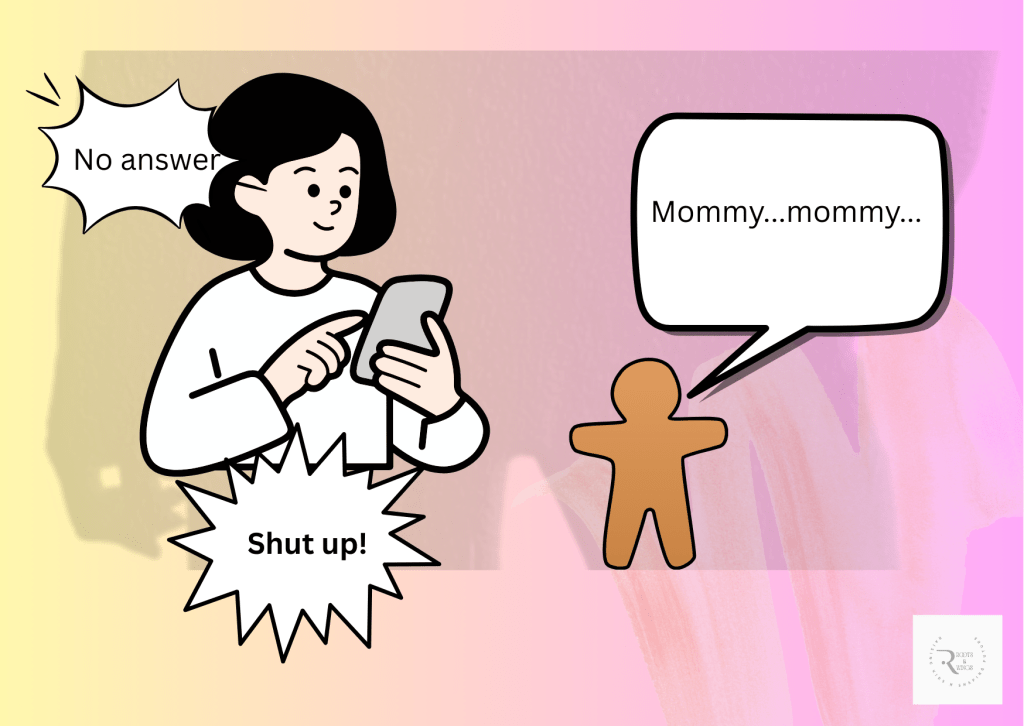
    🎞️Now picture this. A mother immersed in the device in her palm.

    The excited kid calls ‘Mommy…..mommy!’

    No answer.

    Mommy!

    ‘WHAT ⁉️’

    N..nothing 😦

    Child withdraws.

    ⋆˙⟡ Pause for thought. ᝰ.ᐟ

    In all the three real life moments what message are the adults giving to the children?💬 If we don’t form meaningful connection with kids, how will kids share their feelings with us. Then there’s no point complaining that kids don’t listen to us.

    🧩Parenting is not about perfection, it’s about connection. It’s not about eliminating screens, but being present for children. Maybe it begins with one small pause —with eye contact and one fully present moment.

    In my next post, we’ll explore the often unnoticed power of modelling in parenting.

    🎤Over to you! Share your thoughts in comments 🗫

    🌸Let‘s connect on👇
    Instagram

    Facebook

  • Noisy Moments | A Gentle Song | And Calm

    Sharing moments that reminded me that music doesn’t just entertain, it regulates, soothes and teaches calm.

    🎬Picture this- Scene one. Train arrives at the platform. A lot of commotion. Passengers scurry towards the door chugging their luggage. Tempers look frayed. Anyone who has travelled on Indian railways can relate to this.

    But today is different on this train from New Delhi to Ahmedabad. The train pulls in at the station, suddenly a beautiful melodious song from an old Hindi movie fills the compartment. And see the magic 🎼 No, hustle, no bustle, everybody moves forward, in a good mood, humming the same song. I can’t believe my eyes or ears. How come everyone looks so calm in a place so crowded❗  

    🎬Cut to classroom. Scene two. I am teaching a class of 17-year-olds. We have completed the lesson while there were still some ten minutes to go. Students chatter grows louder.  I play the track ‘If you miss the train I’m on…’ on the audio. And to my surprise the chatter stops instantly. Soon students are bobbing their heads to the tune. 🎶

    🎬Cut to Scene three- Morning assembly. The school boasts of a picturesque sylvan setting. The assembly ground is surrounded by trees. If you look up you can see fleet of birds. Every morning some prayer song and some other song or instrumental music is part of the morning assembly. Today the music suddenly disrupted may be due to power failure. And lo, all the birds fly down and perch on the trees forming a circle above the ground and from there rises a cacophony of birdsong. This is surreal! I never imagined that these winged creatures connect so well with assembly music every morning that they actually staged a protest at the disruption.

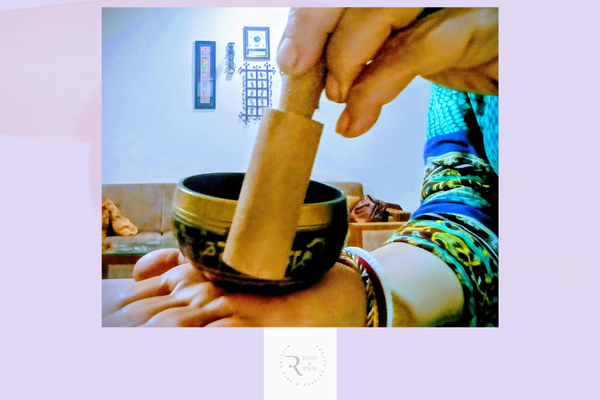
    🎬Scene four. I am at the Uiversity of Rhode Island on an exchange program . We are attending a session at the URI Center for Nonviolence and Peace Studies,  conducted by Thupten Tendhar, (a Geshe, or doctor of Buddhist studies). He gives us a topic for discussion. While we are busy exchanging ideas in groups, suddenly everybody’s attention is drawn to a deep, rich, resonant sound. Discussion stops.  We all turn to find out the source of the deep, pulsating hum. I notice that on the left corner our trainer is tracing the rim of the bowl with the mallet. I am so fascinated with the sound and its effect that I decide I’d also use this tool when I conduct teacher training sessions.

    Such is the calming effect of music on mind. Studies show that hosts of feelgood chemicals, like dopamine, oxytocin, serotonin are released when we listen to or play some soothing music. 🍃

    Next post shares strategies how music can be used as an educational tool to achieve pedagogical goals.

    Have thoughts?  just leave them in the comments!

    🌸Let‘s connect on 👇

    Instagram

    Facebook

  • Role of Mirror Neurons in Child Development

    I was people watching while waiting for someone at the airport arrivals area. People at the arrivals generally look happy to be joined by their families and friends.They greet and hug their loved ones. They might have waited for this moment for a long time.

    One such union I watched up close. It looked like a homecoming of a young man in late twenties. First the mother, so I assumed, hugged him and gave a peck on the cheek. The young man looked embarrassed being so petted by his mother like this. Then the Indian father who looked equally delighted to see his son but being less expansive in his affection gave a pat on his shoulder. Then came the younger sister who was eagerly waiting for her turn and lifted herself a little to hug her brother whose smiling face was visible to me while the girl’s back was turned towards me. At this moment I, an indifferent observer, found myself struggling to hold back my tears for I didn’t want to be seen crying and I had no reason to. As the girl released her rather longish hug and turned her face, I could see her tears while the brother and the parents smiled a tender smile.

    𖡎 How did that happen? I was observing only because all this was happening where I was standing and without any special interest. Still my eyes moistened when the little sister hugged her brother, though I did not see her tears.

    Were the mirror neurons firing in my brain? 🧠⚡🧠

    𖡎 The teacher in me was intrigued with this behaviour. And the first thought I had was if this knowledge of mirror neurons could help teachers, parents and children. I had read about mirror neurons in Dr John Medina’s book ‘Brain Rules’, but I searched some more. This is what I learnt-

    Mirror neurons are cells whose activity reflect their surroundings. Giacomo Rizzolatti, an Italian neurophysiologist and his team are credited with discovering mirror neurons. Their paper on mirror neurons was published in 1990. While performing an experiment on macaque monkeys they observed that the neurons that fired when monkeys picked raisins, also fired when they saw someone else doing the same and even when monkeys did not actually see someone doing it. Later research suggested that mirror neurons respond not so much the physical movement itself, but the intention. This explains my behaviour that day at the airport arrivals area.  🧠⚡🧠

    Having understood the mirror neuron phenomenon I started wondering how that can be applied to in classrooms and home settings and how mirror neurons can support learning. ⋆。°·☁︎

    🚨The first thing we have to know that there’s a mirror brain and if there is, we adults can make use of this in the classroom and home to inculcate the desired behaviour. I mean, we can use this brain behaviour to our advantage in shaping children’s behaviour. This corroborates Albert Bandura’s Social Learning Theory which emphasises imitation and modelling.

    Teachers and guardians can model enthusiasm, curiosity, respect and even thinking processes by solving a problem aloud. and verbalizing thought processes. Self awareness is the key to modelling.

    🚨We can teach children calm, emotional regulation, respond to signals by modelling responses intentionally and consistently. And there’s enough evidence to show that calm, secure and emotionally regulated children not only perform better academically, but are more emotionally intelligent and socially competent also.

    ❝Don’t worry that your children don’t listen to you, worry that they watch you ❞ This famous parenting quote does encapsulate profound wisdom. So next time you yell at children or tell them not to fritter away time online, remember the mirror brain.

    Have more thoughts or tips on this? Share those in the comments below. 💭

    🌸Let‘s connect on👇

    Instagram

    Facebook

  • A Gift is a Double Blessing ✨

    Portia, the most charming and intelligent of Shakespeare’s heroines, said while expounding the virtues of mercy,It is twice blest; It blesseth him that gives and him that takes.⭑ Same can be said of a ‘gift’. It gives joy to both the giver and the receiver. Who gets greater happiness is difficult to tell. Psychologists (Dunn, Aknin, & Norton) say that greater happiness is for the giver.

    💬Has it ever happened with you that you gifted something to someone and they thank you wryly, add that they didn’t like your gift or that they really don’t need any gifts from anyone or actually they don’t very much like the whole idea? How does it feel?

    💬Now contrast it with this. A neighbour, whose kid was my kid’s age, had magnetic letters on the refrigerator which my kid fancied. On one occasion she gifted similar letters to my kid who was overjoyed to receive it.  When my child showed me the gift, I examined the quality of gift and decided it was inferior to the one my neighbour had. You know how adults sometimes think. Of course, I kept my petty thoughts to myself.

    💬My moment of realization came when the next day my kid was happily showing off her gift to all her 4-5 year old friends, who were truly impressed and started arranging those magnets into their names. Then I heard my daughter say ‘Do you like these? You go to that auntie she has given me.’ This was a humbling experience for me. I realised how a small gift has given so much joy, excitement to all the kids. And me! Instead of appreciated the sweet gesture of my neighbour friend, here I’m assessing the value of a gift! Seeing so many happy faces in front of me I knew the gift was invaluable. There are so many things that children can teach us! See, children too shape us.

    🫶The joy of receiving amlifies the joy of giving. A gift that is given cheerfully and should be received cheerfully and gratefully. Gifts strengthen bonds of love and failing to accept gifts hurts the emotions of the giver and creates a negative experience.

    🔆From the positive psychology perspective, the very acts of giving and receiving create positive emotions, positive relations, the two contributing factors for wellbeing according to PERMA model proposed by Martin Seligman, the father of positive psychology. Renowned positive psychologist Roy F. Baumeister and colleagues in a recent study, took on the challenge of determining what makes a good life, and they found some interesting findings that you can apply to your own life. ⋆“Givers” experience more meaning, while “takers” experience more happiness.’ That means, if you are looking for more meaning in life, try giving, and if you are in search of happiness, accept others’ generosity with gratitude.

    One mindful moment at a time – see you soon!

    🗪 Over to you. Leave your thoughts in the comment box.

    🌸Let‘s connect on

    Instagram

    Facebook