My father gave me the best gift I ever received. It has been more than a decade since Pa passed away but his gift I still cherish. It provides the silver lining when the dark clouds loom. To me it’s a source of comfort and a guiding force. It’s like a spring that never runs dry. ༘⋆🌷🫧💭
Whenever a tune thrills me, a verse stirs my soul and words inspire deep thoughts, I thank my father. It was he who kindled in me the love for music and literature through his own passion.📚𝄞
I read this prompt and was prompting myself to write about. I thought of all gadgets, home appliances that made life simple and easy. Then came mobile phone, online banking, cashless transactions.
But most important? I could not zero in on one, the most important, until I read about Dr Glady West, who died recently, July 17, 2026. She is the woman behind GPS. A mathematician whose research laid the groundwork for global position system.
This, of all inventions, is the most important one for me. Why? Because I have always struggled with driving due to my terrible sense of direction. My sense of direction is so pathetic that I could get lost anywhere, even in my neighbourhood. How often I wonder this building was on the left how come it’s come on the right! Now of course, the building won’t move.
If I had to go somewhere, no matter how well someone explained directions I could never trust my sense. At every turn I asked directions. Going anywhere alone meant a lot of stress, even if I had been to a place several times. People invited me ‘Come over, you can drive.’ ‘Yes, I can, but how do I tell you what my problem is’.(´•︵•`)
But all this is a thing of past. No getting lost, nor asking directions ever since GPS came into my life. My life changed. I feel safe, secure, confident. Tell me ‘where to’ and I’ll drive. And since then GPS has become my constant companion on all drives, even when I know the way and I drive to the place frequently. With GPS as my guide, I’m never alone.
Thank you Dr Gladys West for navigating my life! 🌹
You know what! I need a break from daily chores. I don’t want to cook three meals every day and I love to eat home cooked food and have no appetite for ordered food.
I want to go to a place where there’s no laundry, nor dishes, nor cleaning. I want freedom from house work and I want a tidy home.
Even as I am writing I am dreaming of a life where I have some more me time, some more books, my laptop, my kindle, my music system and my long walks with my companion.
I was 10 when some guest speaker addressed us, students, in our school. He expatiated on the virtues of rising early and made a deep impression on young me. Before that, I often heard from my father ‘Early to bed and early to rise…’ ⋆.˚ ☾⭒.˚
⏰So in my early days I made a resolve to be an early bird. I often set the alarm for 4 or 5 am but alarm could never rouse me from my slumberand even if it did I soon dozed back. 💤
My mother finally told me not to set the alarm as it woke up everybody but me. I agreed on the condition that she would get me up. That too didn’t work and whatever time I was up I threw a tantrum why she did not get me out of bed in time. 😫
Decades later my dream of being ‘healthy, wealthy and wise’ is still unrealized. ッ
🌄 I wake up in time to catch the glimpse of the rising sun. I like to behold the ruddy sky in the east. Then i sit or lie down calmly thinking my thoughts. When I’m done I’ll stretch and sit for my Pranayam.🪷 I lie down some more listening to my favourite songs by Pt Jasraj, Kumar Gandharv, Begum Akhtar or whichever song has me under its spell at that moment. I play that again and again. ♫
No chores please! And no plans either!
📚I then pick some books and my kindle too. Those are at the hand so I lift them without having to get up. Surrounded by the books thus, now I pick my phone check mails, messages, feed, some shopping site while books wait for me. One fine moment I’d shove it away, pick a book and immerse myself. Once in a while I pause and wonder at the beauty of thoughts and words. I doze off, read again, listen to the music and keep alternating between these.
🍂Come evening and I need to go for a long walk with a friend, we talk, exchange ideas, sit on the bench or the grass, feel the breeze, gaze up, chill some more…some writing before retiring. 😴
Oh, I didn’t say a word about meals. I don’t want to give much thought to it. Fruits, juices, soups, coffee would be fine on an ideal day. 🍍🍎🍓🍇☕⛾☕︎
Like Rudyard Kipling’s Yellow Dog Dingo, I am ‘always hungry’ (📚). I want to reread so many from Shakespeare’s tragedies, comedies to Coleridge’s The Rime of Ancient Mariner, to Kipling’s Just So Stories, Jungle Book, to Midnights Children, to all the books by Hans Anderson, all the books by Jim Corbett, all the books by Munshi Premchand and so many more.
However, currently on the top is the latest book by Salman Rushdie ‘The Eleventh Hour’ and one audiobook ‘Sunny Boy’. Guess who wrote this.
(﹙˓ 🎧 ˒﹚)The noise. The blaring loud speakers, be it a festival or a wedding or victory. Also people sitting close and talking loudly at high pitch makes me recoil.
Hey, don’t get me wrong. I love soft, calming , soothing sounds. 🎹🎶 𓂃 ོ☼𓂃 ⊹ ࣪ ﹏𓊝﹏𓂁﹏⊹ ࣪ ˖
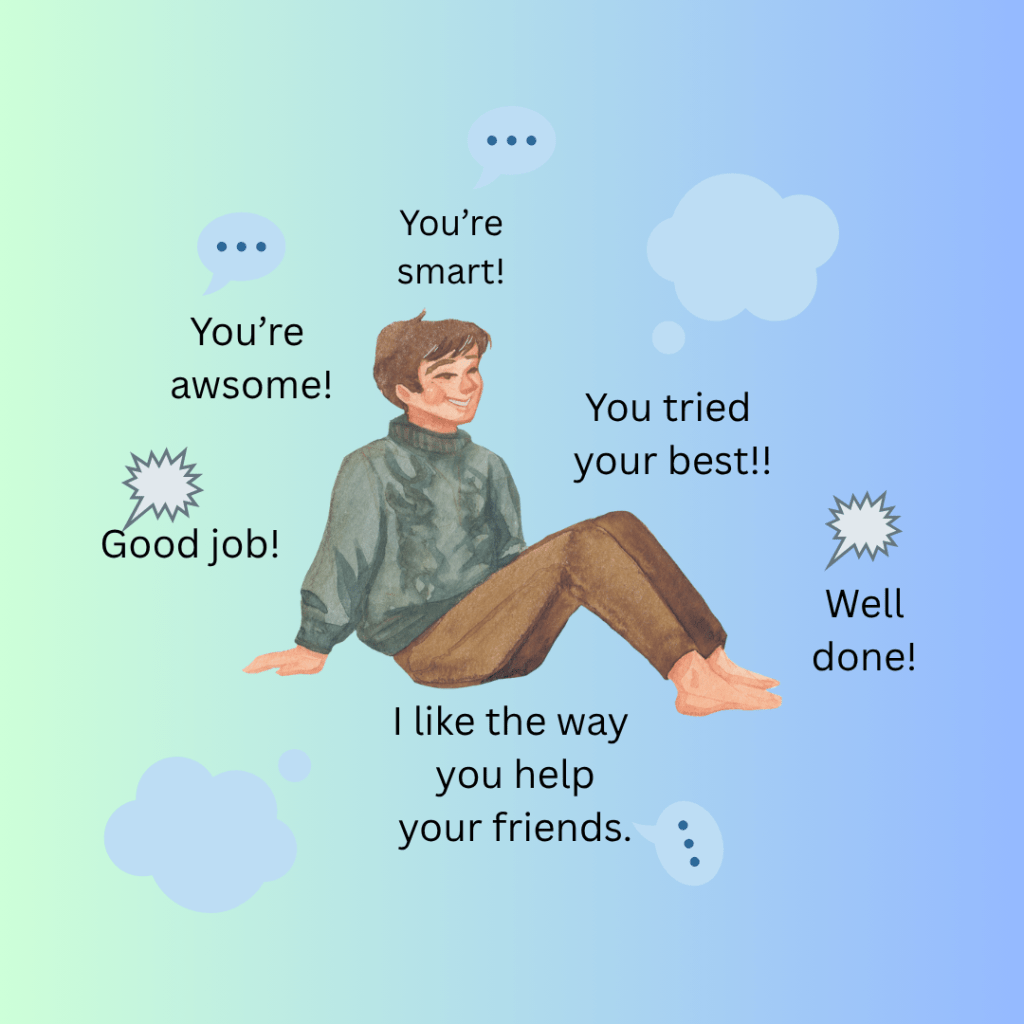
Praise is a skill, not just a spontaneous utterance.It is a powerful tool in the hands of those who are responsible for children’s education and upbringing. Like all powerful tools it has to be used carefully and mindfully.
Children instinctively respond to praise. Much before their language develops they recognize praise in your smile and in your eyes. And when they sense your approval and appreciation they repeat the same act again and again. Just to please you. The right praise, offered at the right moment and in the right manner can work wonders.
I think BF Skinner did a great service to mankind by propounding Learning by Conditioning and its key concept of reinforcement. Through his experiments he showed that behaviours followed by a reward are more likely to be repeated. And praise is one such reward. A child can be rewarded in other ways too, with a gift, with a treat, but immediate praise is the most handy and effective award. If used skilfully, this tool can mould the child the way you want and you’ll find that gradually your nagging is also tailing off. So, it’s like getting double benefit, getting two-for-one. ‘Spare the rod, spoil the child’ is old school. The proverbial rod can be done away with. Punishment doesn’t bring any lasting change, instead it causes anger and hostility. Well, our focus here is not the rod, but praise and how it can be used bring desired changes in the child behaviour. Yes, Change is possible!
Which compliments would motivate the child and reinforce the desirable behaviour?
Here’s my manual on how to pack more power to praise –
✦︎What to praise?
Praise the behaviour you want to reinforce. Let’s say, you want the child to keep her things properly, or to be polite and helping to her friends in the class or to be ready on time for school. Depending on the age and developmental stage of the child, identify the behaviour you want the child to repeat.
Talk to the child about the importance of a good habit/behaviour you want her to acquire. Talk, connect without being after the child about the same thing all the time, nor expect complete compliance or perfect behaviour immediately. For the sake of peace you can ignore the undesired behaviour once in a while, but don’t ignore it when the child takes even a tiny step in the right direction, that’s your opportunity, seize it. Small efforts bring big change. This is positive psychology. This is positive parenting. Be alert, catch these small steps, these small moments, and let the child know that her efforts are recognised and appreciated, ‘Today you got ready earlier than yesterday, next time try to get ready by…’ ‘I really like you are trying to be on time’ ‘your table/shelf looks tidy today. Thanks for organising it so well.’ ‘You let your friend play with your ball. That’s good.’ The smallest progress should be made a news for the child and other family members or for the class. As I often say ‘News of the difference makes a difference.’ Not just verbally, offer nonverbal praise too, smile, hug, touch, gentle look would give more power to your words.
✦︎When to praise?
As soon as you notice improved behaviour or as soon as possible. Delayed praise brings diminished returns. Sometimes for practical reasons you cannot offer praise immediately which shouldn’t be a cause of concern, take it easy. Parenting is not about perfection. You can even convey through someone else if that is possible. That also works well. Child would feel motivated when someone at home will tell her ‘Pa is pleased that you learnt your lesson all by yourself.’
I recall an incident. On one occasion my colleague conveyed my genuine praise to my 12th grade student who had lately started taking more interest in studies. While she was taking my proxy she told him ‘Renu ma’am was very happy with your work. She told me you have acquired a good understanding of the concepts and you express yourself beautifully.’ Need I tell you this communication boosted that student’s self-esteem forever and he started participating in my class more actively. It was so thoughtful my friend to communicate my genuine praise to the right person.And praise works for all children irespective of their age. It will make lasting changes in the behaviour.
✦︎How to praise?
Don’t wait for the perfect result. Don’t keep telling ‘Not good enough, try harder.’ It’s so demotivating. One statement can put the child off the track. Instead say, ‘You’re trying really hard, you’ll get there. This is how we all learn.’ Focus on effort, outcome can wait.Doesn’t The Bhagwat Gita also teach the same thing? Focus on your actions and not on the result of your actions.
•Again praise actions, behaviour, not the personality. Say ‘I like that you always talk to your elders with respect’ and not ‘you are a nice girl’ ‘you are a genius’etc.
•The more specific the praise, the more effective it will be in reinforcing the desired behaviour.
•Let non verbal praise complement your words of praise.
✦︎How much praise is good and how much is too much?
If your praise is genuine and sincere, it can’t possibly be too much. It would be just right. According to Alan Kazdin, a Yale professor and Director of Yale Parenting Centre ‘You might be concerned about praise spoiling the child. But both research and clinical experience suggests this is not really an issue.’ He further adds that we are not likely to praise too much because of our negativity bias which means our tendency to look for what is wrong.
🚦A word of caution here:
Heaping the child with compliments for nothing particular will do more harm than good. Also, use praise for reinforcement, not for coaxing and manipulation.
Thus, praise is a skill and a very crucial onefor parents and educators to acquire in order to modify children’s behaviour and inculcate growth mindset in them.Developing this skill involves continuous practice and refinement.
🗪 I’d love to know what’s your take on this subject? Leave your thoughts in the comment box.
Since this space is about nurturing and educating with positive psychology it would only be appropriate to decode positive psychology for you at the outset.
Positive psychology emerged as a scientific framework at the cusp of 21st century. It is a subfield within psychology and Martin Seligman, a prominent American psychologist, is called the father of positive psychology. Its distinctive feature is its strengths-focused approach.
Though in the more recent years it has created quite a buzz yet not many people know that it is born out of years of scientific research and studies by psychologists like Seligman and Mihaly. Carol Dweck, Jonathan Haidt, Christopher Peterson are some of the leading names in the field. As Peterson puts it “…positive psychology is not to be confused with untested self-help…”. Here I’m trying to answer some of the questions that may already be swarming your mind.
What is strengths-focused approach?
Strengths-focused approach focuses on the strengths of individuals rather than on their shortcomings. There are moments when people are not ill or unhappy (no negative feelings) and yet they don’t feel happy or strong either(no positive feeling). This is where positive comes in. It aims at fostering happiness, strength and well being. And whatever we focus on multiplies, grows. Focus on health, happiness, hope, gratitude, interest, positive relationships enhances well-being, happiness and life satisfaction.
In other words, positive psychology is not all about fixing problems but about promoting strengths and making life worth living. This is what Seligman means when he says “The best therapists do not merely heal damage; they help people identify and build their strengths and their virtues.”
Is it the same as positive thinking?
That’s a common confusion. The basic difference between the two is- positive thinking is a mindset that expects good outcomes always, while positive psychology is a scientific study based on research.
Positive psychology is more realistic. It accepts that things may go wrong too. It understands and acknowledges negative feelings without giving them more power. It moves ahead to nurture strength and fulfilment.
How is it different from the psychology as we have always known?
As for Psychology as we know or let’s say traditional psychology, the primary concern is illness, disorder and dysfunction. Traditional psychology fixes what is wrong. It’s about surviving. On the other hand, Positive psychology interventions are about improving emotional health, social relations, and outlook by creating positive emotions, building capabilities and creating positive relationships.
And this is the main and the only difference. In the end, these two don’t contradict each other. In fact, they complement each other.
Enough! This is getting too long and theoretical. Alright, having gained the direction and the basic understanding of positive psychology, we now can glide into practical applications on how we can help kids (and adolescents) achieve their full potential and fulfilment.
Have more questions? Drop them in the comment section.





 Roots n Wings